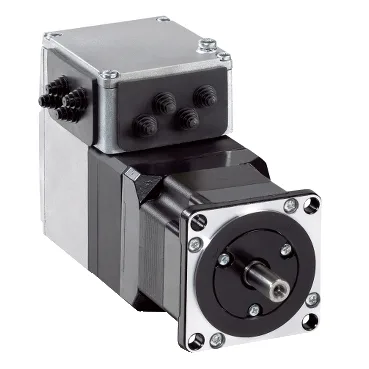
Where it sits on the machine
The ILA2T571PC1F0 is a Lexium ILA AC synchronous servo motor with an integrated holding brake, designed to drop into the compact 57 mm flange mounting pattern typical of indexing tables, small pick-and-place axes, and packaging-machine cam followers where a braking fail-safe is wanted without an extra panel enclosure. Flange mounting with a 20 mm shaft length and a 9 mm untapped shaft end means it bolts straight to the driven load, so the retrofit question really comes down to whether the existing bracket has the same 57 mm register — meet it where it is and a 1990s axis gets modern motion without rewiring the cabinet.
Torque, speed, brake envelope
Nominal torque is 0.44 N.m (3.89 lbf.in), with a peak stall of 0.62 N.m (5.49 lbf.in), so the part is sized for low-inertia indexing duty rather than continuous heavy pulling — pick a larger frame when the cycle torque spends most of its time over the 0.44 N.m line. Rated speed is 3200 rpm at 24 V and steps up to 5100 rpm at 48 V, which lines up with the Lexium ILA drive family's DC bus range rather than a fixed AC mains input — confirm the drive output rating before assuming a higher-speed profile. The holding brake delivers 1.2 N.m (10.6 lbf.in) of static holding torque, releases in 14 ms, and pulls in at 10 W, so it cuts power quickly enough for a vertical-axis anti-drop function but does not double as a dynamic braking resistor — heat from repeated rapid stops still walks back into the motor housing.
Feedback and protection floor
Position feedback is a single-turn encoder with a stated accuracy of +/- 0.05 degrees, which is sufficient for point-to-point indexing and cam profiling but does not retain absolute position across a power cycle; if the line needs to know where it is after an E-stop, the controller has to home the axis on restart. Built-in protection covers short circuit of the output voltage, overload of output voltage, and safe torque off (STO), so the drive interface handles the wiring-side faults that would otherwise be caught externally — STO lets the safety circuit drop torque without cutting bus power. Cooling is natural convection only, with current consumption capped at 5000 mA continuous and 7000 mA peak; a sealed enclosure derates the allowable cycle rate, and a fan-forced housing or higher-duty frame should be substituted if the ambient inside the cabinet trends above the 15-85% non-condensing humidity envelope the motor is rated for.
Compliance record on the nameplate
Marking is CE, and the motor is tested to EN 61800-3: 2001-02, IEC 61800-3 second environment, IEC 50347, IEC 60072-1, and IEC 50178, which covers EMC in industrial (second-environment) installations and the dimensional/mechanical interface standards for small-frame rotating machines. Shock resistance is 150 m/s² for 1000 shocks (IEC 60068-2-29) and vibration resistance is 20 m/s² across 10-500 Hz (IEC 60068-2-6), so the unit survives press-side mounting and high-cycle pneumatic neighbours without a separate shock mount.
Wiring footprint and commissioning notes
Connection is via an industrial connector rather than a fixed conduit, and four signal lines are available as programmable inputs or outputs — so a single cable harness carries power, feedback, the brake, and the four I/O channels, simplifying the panel-side gland layout. Network throughput is 10/100 Mbits on the integrated comms port, so the drive+motor pair talks standard industrial Ethernet speeds and slots into a Lexium ILA commissioning toolchain without a separate gateway. The motor package measures 190.8 mm in length and ships one unit per package, so the bracket clearance and the spare-parts shelf footprint match a 7.5 in long small-frame servo — useful to know when a kitting cabinet drawers a sibling part for an MRO swap.