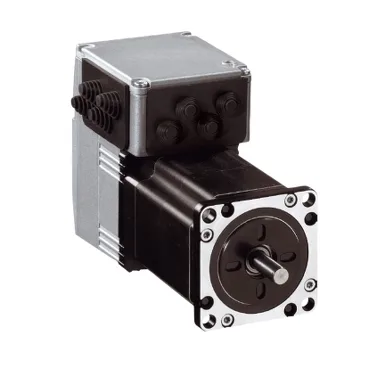
Lexium ILE — a drive married to its motor
The ILE1F661S1982 sits inside Schneider's Lexium integrated drive line, a brushless DC motion block where the power stage and the 66 mm flange motor share one housing so the cabinet side only has to land DC bus, logic, and a feedback cable. It runs from a 24 V or 36 V DC bus (18…40 V supply limits) and is sized for a 5.5 A maximum continuous draw with a 7.0 A peak, so a 10 A branch fuse clears faults without nuisance tripping on accel transients.
Control loop and feedback
Feedback is taken from a BLDC encoder mounted on the motor, on a 6-pole, single-stack winding tuned for medium speed and medium torque — the fit for a packaging indexer, a small conveyor, or a divert arm rather than a high-inertia spindle. Four bidirectional signals sit on the same logic interface alongside the two STO safety inputs; the 24 V signal interface thresholds are 15…30 V for state 1 and −3…4.5 V for state 0, which lines up directly with a 24 V PLC sink/source output without level shifting.
Safety, thermal, and the panel envelope
Safe torque off is built in, along with output short-circuit and output overload protection — a category-3 stop function is achievable without adding a contactor upstream of the drive. Cooling is natural convection only, and the device is rated for 0…50 °C ambient without derating; the motor winding itself is permitted up to 110 °C and the power amplifier to 105 °C, so the heat path is internal and an enclosure with a single fan or passive vents is enough at typical cabinet densities. Mounting is flange style on a 66 mm motor face with 4.4 mm holes; sealing is IP41 at the shaft bushing and IP54 over the rest of the body, so a covered machine frame keeps dust off without requiring a washdown enclosure.
Compliance and ruggedness
The unit carries CE marking and is tested to IEC 50178, IEC 50347, IEC 60072-1, and IEC 61800-3 Ed 2 in the second-environment EMC envelope, which is the configuration expected when the drive sits on the machine side of an industrial panel rather than in a residential or light-commercial zone. Mechanical resilience is rated at 150 m/s² for 1000 shocks and 20 m/s² across 10…500 Hz sweep per IEC 60068-2-6/29, and operation is derated above 1000 m altitude — both values a buyer should sanity-check against the machine's transport and installation profile.