What you're actually bolting to the panel
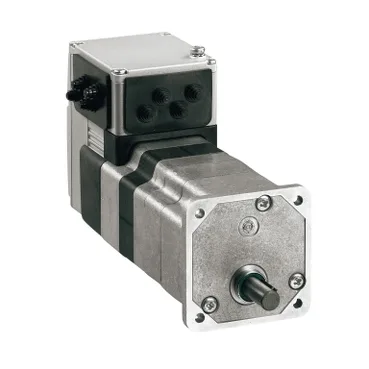
The ILE2P661PB1A4 sits in the Lexium ILE integrated-drive family — a brushless DC motor, straight-tooth four-stage gearhead, and drive electronics in one 66 mm flange package. Winding is the medium-speed / medium-torque variant, so it lands in conveyor indexing, valve actuation, and small-format dosing lines rather than high-rpm spindle service. Output is a keyed shaft, 10 mm diameter by 25 mm long with a 16 mm key, no holding brake and no second shaft end — the load holds position through the gear alone when power drops.
Headline ratings — what 12 N.m at 44 rpm actually buys you
Nominal torque is 12 N.m at both 24 V and 48 V, so the motor runs the same duty point off either supply — useful when the cabinet has 24 VDC already and a 48 V tap isn't available. Nominal speed shifts with the rail: 35 rpm at 24 V, 44 rpm at 48 V. That's the gearhead output, not the motor shaft — the 115:1 reduction (3675:32) drops a much faster BLDC down to usable indexing speeds. Peak stall torque tops out at 24.72 N.m on either supply, roughly 2x nominal — the headroom for breakaway on a sticky valve or jammed conveyor flight before the drive folds back. Continuous output power is 54 W at 24 V and 68 W at 48 V. The rating that actually governs a slow indexer is the torque envelope, not the watts — pick by load inertia and cycle time first.
Drive electronics and the bits you'll wire to
Logic and power land through a printed-circuit board connector — no separate cabling harness to chase, and the I/O block exposes 4 signals each configurable as input or output. Built-in protection covers output short circuit, output overload, and safe torque off — the STO function lets you hard-wire a guard door into the drive without a separate safety relay. Peak current draw is 7000 mA, continuous max 5500 mA — the upstream 24 V or 48 V supply has to be sized for the inrush on every move profile, not the average draw. Cooling is natural convection only — no fan to fail, but the motor flange and surrounding panel metal become the heatsink and the cabinet layout needs to leave clearance around the body.
Gearhead precision and how long the bearings actually last
Accuracy is rated at +/- 0.5 point — fine for open-loop indexing where the downstream process sensor takes the true position, less suitable when the motor itself is the only position reference. Detent torque is 9.19 N.m, meaning the gearhead holds position back-driven up to that figure with power off — useful for vertical or biased loads where creep would drift the output. Bearing service life is split: 2500 hours short-term operation, 15000 hours long-term. Pick the duty profile against the expected hours-per-shift, not against an L10 marketing number.
Mechanical envelope and the panel hole you cut
Overall length is 174 mm with a 66 mm flange and a 4 mm centring collar depth — that's the back-plate pattern you build the bracket around. Flange mounting is the supported configuration; the body length plus the keyed output shaft set the minimum clearance behind any obstruction.
Standards, environment, and where it legally goes
Marked CE and built to EN/IEC 61800-3 (the drive EMC standard), EN/IEC 50178 (power converter safety), EN 50347 (motor dimensions), and IEC 60072-1 — second-environment EMC category per the 2001 edition, meaning industrial-area use without special mitigation. Shock resistance is 150 m/s² for 1000 shocks and vibration 20 m/s² from 10 to 500 Hz over 10 cycles, both to the EN/IEC 60068-2 series — heavy enough for most process skids and many mobile-platform fits.
Sourcing reality for the line-down RFQ
No official successor or cross-reference is on the record for this order code — the BOM line is its own line, and a board-spin to a different package is the only escape route if supply tightens.