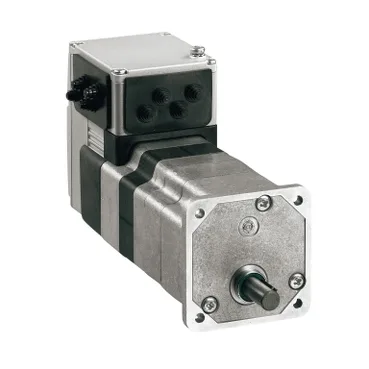
Active production line, 115:1 worm-gear servo at 24/48 V
The ILE2P661PB1A8 is the Schneider Electric Lexium ILE integrated drive — a brushless DC servo with on-board electronics, sized into the 66 mm flange, 229 mm length envelope and built around a 3-stage worm gearbox with a 115:1 (3675:32) reduction ratio that lands the output shaft at 35 rpm whether the bus is held at 24 V or 48 V. That 115:1 ratio is what drives the so-what on this part — the low output speed pairs with a 16.7 N·m detent torque and a 10.6 N·m nominal / 24.72 N·m peak stall torque window at either supply voltage, putting the unit squarely into positioning and indexing duty (dampers, diverters, slow conveyor gates) where the integrated gearbox removes the need for a separate reducer on the driven shaft.
Electrical envelope and protections
Supply limits run 18–55.2 V DC, which means the drive accepts the same 24 V and 48 V cabinets typical of low-voltage motion subsystems; current draw is capped at 7 A peak with a 5.5 A maximum continuous ceiling, and nominal output power is rated 37 W at 24 V or 39 W at 48 V. Protection set covers safe torque off (STO), output voltage overload, and output short-circuit — the STO function in particular is the channel an integrator ties into the safety circuit when the load must drop torque without removing bus power. Cooling is by natural convection only — no fan, no blower — so the ILE2P661PB1A8 has to be mounted with the heatsink surface clear of insulation; derating starts above the 1000 m altitude ceiling and across the 15…85 % non-condensing humidity window.
Feedback, I/O and the fieldbus slice
Feedback is a BLDC encoder built into the motor, with +/- 1 point accuracy, and the drive exposes 4 signals that can each be configured as input or output — enough for end-of-stroke limits, a home switch and a fault contact without an external I/O brick. Network side runs on a 100 Mbit/s link rather than a traditional analogue +/-10 V torque/velocity pair, so this drive lands on the modern fieldbus/industrial-Ethernet motion segment rather than the legacy analogue servo slot — a panel retrofit that drops the unit into an analogue-only control cabinet will need the matching communications gateway. The PCB connector for power and signal is on the drive body — no separate through-panel plug — which simplifies the enclosure cut-out but means cable dressing is on the integrator rather than the part.
Mechanical fit and lifecycle duty
Mechanical mounting is flange-based on the 66 mm motor flange; the shaft end is a hole rather than a solid round, and the unit is supplied without a holding brake and without a second shaft end — anything that needs a brake must be specified at the BOM stage, since there is no field retrofit path. Bearing service life is 9000 h, shock resistance is rated 150 m/s² for 1000 shocks and vibration 20 m/s² across 10…500 Hz — a duty envelope that covers slow-cycle industrial indexing rather than continuous high-cycle rotary motion.
Compliance and series positioning
The drive carries CE marking and is designed against IEC 60072-1 (motor frame dimensions), EN 61800-3:2001 second environment (the industrial-grade EMC class, not the stricter first-environment / residential class), EN 50347, IEC 61800-3 Ed 2 and EN/IEC 50178 — the standards stack that lets the unit sit on a factory-floor machine without additional filtering beyond the second-environment limits. Within the Lexium integrated drive family the ILE sits as the compact, low-voltage DC-bus position-control member, complementary to the larger Lexium 32 servo amplifiers that handle the higher-power AC-bus axes — the differentiator here is the integrated worm gearbox, which most of the larger-frame Lexium members do not carry on-board.