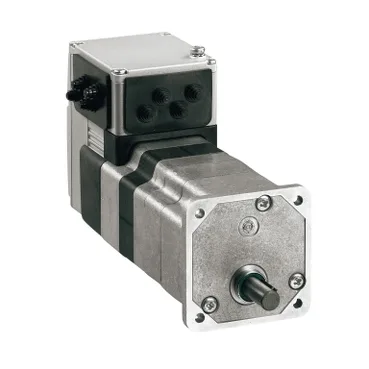
Active in the ILE line — quoted against the BOM
The ILE2P661PC1A2 sits inside Schneider Electric's Lexium ILE integrated-drive family, where the controller, comms stage and brushless servo motor share one housing — useful when the cabinet side loses an enclosure slot but still has to drive a real load. A first fit-check against an existing axis: the unit is flange-mount on a 66 mm motor flange with a 10 mm keyed shaft and a 25 mm shaft length, so it drops into a standard ILE cutout without re-machining the mounting plate.
Mechanical envelope — 38:1 gear, 7.3 N·m nominal
The gearbox is a 3-stage straight-tooth set with a 38:1 reduction (75:2 form), so the input speed the drive sees is roughly 38× higher than the output shaft — at the rated 107 rpm at 24 V / 133 rpm at 48 V the motor stage is rotating around 4,000–5,000 rpm before the gear train. For a retrofit that means the existing 38:1 coupling, sprocket or belt ratio carries straight across. Torque staged correctly matters more than the headline number: continuous nominal torque is 7.3 N·m at both 24 V and 48 V, and the peak stall is 13.07 N·m at either supply rail — the limiting figure for sizing is peak stall torque, because that is the ceiling the application sees on accel/decel events, not the steady-state rating. Output power at the nominal point is 95 W at 24 V and 119 W at 48 V — running the unit at the higher rail shifts output up by about 25 % at no change in torque, which is the cleanest upgrade path on a 24 V cabinet that can accept a 48 V bus.
Drive stage — 48 V DC, 4 digital I/O, RS-485
The drive side is a single-phase DC bus, drawing 5,500 mA maximum continuous and 7,000 mA peak at the input — the cabinet PSU must be sized to the peak, not continuous, or the drive will trip on inrush. Braking is regenerative into the DC bus because the unit ships without a holding brake and has no second shaft end — for a vertical axis the customer-side mechanical brake is non-negotiable, but the ILE itself remains compact. Comms link runs through an industrial connector at 100 Mbit/s, with four software-configurable signals on the I/O block — enough for two limit switches, enable, and a status output without needing a remote I/O slice. Protective behaviour is the usual Lexium triad: output over-voltage, safe torque off, and output short-circuit — STO is the relevant one when this unit lands in a machine guarding circuit, and the safety chain should be wired directly to the STO inputs rather than rely on enable over comms.
Siting envelope — cabinet, altitude, vibration
Length overall is 174 mm with a 4 mm centring collar, so any retrofit drawing that shows the standard ILE envelope will accept this code without bracket rework. Environmental envelope: 15...85 % relative humidity non-condensing, operating altitude under 1000 m without derating, shock resistance 150 m/s² and vibration 20 m/s² across 10...500 Hz — it sits happily inside a typical panel-builder enclosure and on a machine frame that sees modest reciprocating duty.
Compliance — EN/IEC 61800-3, CE marked
Compliance is built into the datasheet envelope: EN/IEC 61800-3 (second environment), EN/IEC 50178, EN 50347, IEC 60072-1, and CE marking — the drive-side emissions class follows the second-environment EMC profile, which is the industrial-factory assumption rather than light-commercial.