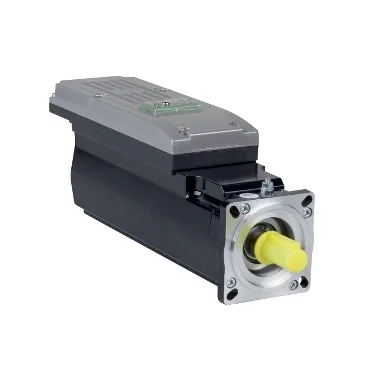
Form factor the apprentice can put a tape on
The ILM0703P31A0000 sits in the PacDrive 3 range as an ILM-series servo motor integrated drive with a 70 mm motor flange and a 259 mm body length, so the bench layout the junior sketches on the back of the panel drawing matches the actual footprint the motor drops into. Four 5.5 mm mounting holes on an international standard flange with a 60 mm centring collar at 2.5 mm depth lock the motor to the machine sub-plate — bring these dimensions to the mechanical side before the wiring day, not after.
Operating envelope: 720 W with headroom for accelerations
Continuous rating is 720 W at 6000 rpm nominal speed, with 1.15 N·m of nominal torque and 1.5 A line current; the peak stall torque of 8.7 N·m and maximum Irms of 12 A give the integrator the dynamic headroom to accelerate inertial loads without leaving the continuous envelope during steady-state. Continuous stall torque sits at 2.2 N·m at 3 A, so the holding figure under stationary load is roughly twice the running figure — that gap is what the motion controller reads as available torque margin during a move profile.
Feedback, electrical constants, and the rotor the drive has to tame
Position feedback is an absolute single-turn SinCos Hiperface device at 128 periods of resolution, so the PacDrive 3 controller gets absolute position on power-up without a homing move — useful on a line where the apprentice has to recommission after a power dip without re-zeroing every axis. Stator winding drops from 13 mH phase-to-phase at 20 °C to a lower phase-to-neutral figure at 120 °C, and resistance falls from 2.7 Ω to 1.88 Ω over the same span — the drive's current loop will see a warmer, lower-impedance motor at operating temperature than at cold start.
Mechanical limits at the shaft
The keyed shaft is 14 mm diameter by 30 mm long with a 20 mm key width and no second shaft end, so any side-mounted accessory (encoder stub, hand crank, tach) is off the table on this build — spec the gearbox or coupling to take everything off the drive end. Maximum radial force Fr drops from 730 N at 1000 rpm to 400 N at 6000 rpm — a belt or pinion mounted off the shoulder must be derated as speed climbs, not held at the low-speed figure, or the bearing budget silently disappears. Axial load is capped at 0.2 × Fr, and there is no holding brake on the motor — if the application needs to hold position with the bus off, the brake belongs on the gearbox or on a downstream mechanism, not on this part number.
Sealing and cooling for the floor, not the bench
Cooling is natural convection with no integrated fan, and the enclosure rating is IP65 — the motor can sit next to a washdown station or in a dusty cabinet without an air supply, but the installer still has to keep the cable glands torqued and the shaft seal clean, because IP65 is about the as-installed assembly, not just the motor body.