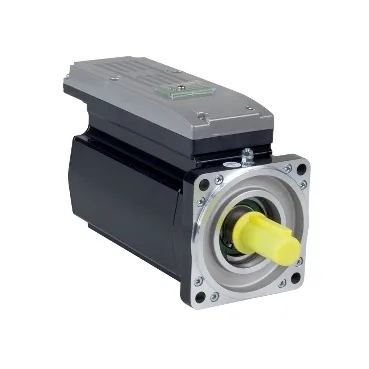
ILM1001P02F0000 — what lands in the panel
The part is a Schneider Electric ILM-series integrated servo motor in the PacDrive 3 range — the drive electronics sit inside the motor housing rather than in a separate cabinet, which removes one cable run and one panel slot per axis on a packaging or assembly machine.
Torque and speed envelope
Continuous rating is 600 W output with 1.9 N·m nominal torque at 3000 rpm, so the working point for a typical sizing calculation sits well inside the 2.5 N·m continuous stall and 9.6 N·m peak stall envelope — peak is roughly five times nominal, which is the margin the drive uses for accel/decel transients. Continuous current is 1.4 A against a 7.4 A Irms maximum, so the drive's current loop has roughly five times headroom over the rated working point — that ratio is what lets the motor accelerate an inertial load without saturating the controller.
Feedback, brake, and electrical constants
Position feedback is absolute multiturn SinCos Hiperface, which means the absolute position is valid at power-on without a homing move — the controller knows shaft angle before the first motion command, which simplifies machine startup and recovery after an e-stop. An integrated holding brake delivers 5.5 N·m of static torque, sized to hold the vertical axis against gravity when the bus drops — the brake is the failsafe element, not the dynamic stop, so dynamic braking energy has to stay within the drive's internal absorption. Stator resistance measures 9.8 Ω phase-to-phase at 20 °C and back-EMF constant is 90 V/krpm, so the drive's bus voltage ceiling and the motor's back-EMF at top speed have to be checked together — running above the field-weakening threshold with this back-EMF constant will trip a DC-bus overvoltage.
Mechanical envelope and shaft loading
Flange size is 100 mm with an international-standard flange mount, 9 mm mounting holes on a four-bolt pattern, and a 19 mm shaft — this is the standard mounting footprint for an ILM 100-frame motor, so any existing machine bracket or gearbox input sized to this frame accepts the part without machining. Maximum radial force is 900 N at 1000 rpm derating to 630 N at 3000 rpm, with maximum axial force capped at 0.2 × Fr — at top speed the coupling or pulley choice drives the radial load budget, not the bearing's static rating, so a separate shaft-loading calculation is required for belt and pinion drives.