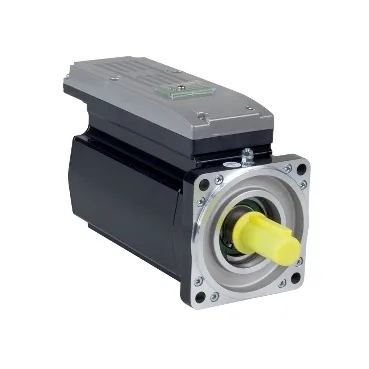
Fit check on a PacDrive 3 axis
The ILM1002P02A0000 is a PacDrive 3 ILM-family servo motor integrated drive sized at a 100 mm international-standard flange, drawing continuous torque of 2.9 N·m (38.9 lbf.in stall) and capable of 18.3 N·m (162.0 lbf.in) peak stall for short accelerations — the figure that decides whether it survives the worst-case acceleration step on a web, packaging, or pick-and-place axis without tripping the drive on Irms. The 13.1 A Irms ceiling gives roughly 4× margin over the 2.9 A continuous stall current, which is the headroom PacDrive sizing tools use when matching the motor to the LXM/PacDrive controller.
Shaft, flange, and what bolts to it
Mounting is an international-standard flange with a 95 mm centring collar (3.5 mm depth) and four 9 mm mounting holes — a 100 mm flange bolt pattern, so the gearbox or coupling must be sized to that face, not the older 85 mm metric pattern. Shaft is 19 mm diameter × 40 mm long, untapped, no second shaft end and no holding brake; the mating coupling must clamp to the shaft and the load-side brake (if the application calls for one) lives on the gearbox input. Maximum radial load Fr is rated 990 N at 1000 rpm and falls to 690 N at 3000 rpm — the gearbox output bearing must keep the pinion mesh reaction inside that envelope at the top of the speed range, not just at standstill. Maximum axial Fa is 0.2 × Fr, so thrust from a timing-belt tensioner or a vertical screw preload needs to be checked against that figure before the coupling goes on. Overall length is 249 mm with a 30 mm key width — confirm the cabinet envelope before committing the BOM line.
Thermal envelope and where the motor actually sits
Cooling is natural convection only — no integrated fan, no forced-air option in this variant — so the continuous torque rating assumes the body dissipates into still ambient air at the rated temperature class. Stator resistance drops from 4.12 Ω phase-to-phase at 20 °C to 2.86 Ω phase-to-neutral at 120 °C and stator inductance from 21.8 mH to 10.9 mH across the same span, while the torque constant of 1.52 N·m/A is specified at the 120 °C hot point — meaning the motor is rated and characterised at its thermal ceiling, and the controller's auto-tune must be run with the motor warm, not cold from the shelf, to land on the right gains. IP54 sealing on the body keeps splashing coolant and plant dust out of the air gap, which fits general factory-floor duty but rules out direct washdown zones. Nominal output is 910 W at 3000 rpm nominal speed, with the back-EMF constant of 100 V/krpm at 20 °C — the controller's bus voltage must support the full speed envelope or the field-weakening range has to be derated accordingly.