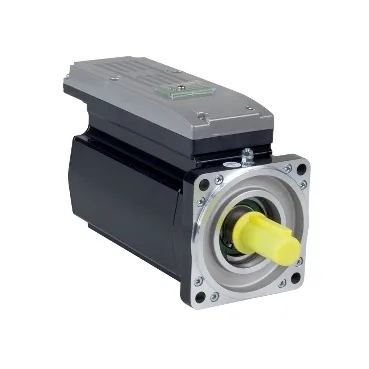
The Schneider Electric ILM1002P11A0000 is an ILM-series integrated servo motor in the PacDrive 3 family, combining the motor and its drive electronics in a single flange-mounted package rather than separating the drive cabinet from the machine mechanics. PacDrive 3 is positioned as Schneider's high-end motion platform for packaging, converting and material-handling machines, and the ILM form factor targets applications where the drive-on-motor integration cuts cabinet space and removes the separate drive-to-motor power cable run.
Torque, speed and power envelope
Continuous torque is 2.9 N.m at the rated 3000 rpm, which lands the unit in the small-frame PacDrive 3 segment — sized for light web-handling, small cross-axis positioning stations and indexing tables rather than the heavy press work that the larger ILM frames carry. Peak stall torque of 18.3 N.m against a continuous stall torque of 4.4 N.m gives roughly a 4× dynamic headroom for acceleration pulses, which is the figure that determines whether the motor can move the load through the machine cycle without tripping the drive into current-limit. Nominal output power is 910 W and nominal line current is 2 A, while the maximum RMS current reaches 13.1 A — that current ratio is what the upstream drive sizing has to clear, not just the nominal figure, when the motion profile calls for short bursts at peak torque.
Feedback, cooling and brake configuration
Feedback is Hiperface SinCos absolute single-turn with 128 periods per revolution, which suits PacDrive 3 controllers that expect absolute position on power-up and SinCos incremental interpolation for high-resolution commutation — the absolute layer avoids a homing move after every E-stop. Cooling is natural convection with no integrated holding brake, so any axis that must hold position under gravity needs a separate mechanical brake on the downstream gearbox or a brake-rated gearbox; the motor itself cannot be specified as a fail-safe stopping element. Stator resistance climbs from 4.12 Ohm at 20 °C to 2.86 Ohm at 120 °C per phase and stator inductance drops from 21.8 mH to 10.9 mH over the same span, which is the thermal headroom the drive commissioning engineer must respect when sizing the current-loop bandwidth for a hot machine.
Mechanical envelope and load limits
The flange is the 100 mm international standard with four 9 mm mounting holes on a 95 mm centring collar, and the keyed shaft is 19 mm diameter by 40 mm long — typical for small-format PacDrive 3 frames that bolt to a planetary gearbox input. Maximum radial load is 990 N at 1000 rpm, falling to 690 N at 3000 rpm, and maximum axial load is capped at 0.2 × Fr; an overhung pulley or a long cantilevered coupling can exceed that envelope quickly, so the coupling selection and shaft-side geometry should be checked against the Fr curve before commit. IP54 sealing means the motor is protected against dust ingress and splashing water, which is acceptable for general industrial enclosures but not for washdown zones — a brewery CIP room or a food line would need a higher IP rating or a cover.