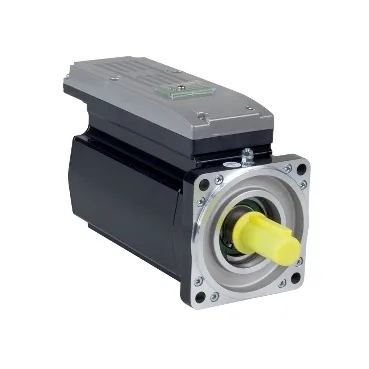
A 910 W PacDrive 3 motor with the torque headroom for short bursts
The Schneider Electric ILM1002P12A0000 is an integrated servo motor in the PacDrive 3 ILM family, sized for 910 W of nominal output power at a 3000 rpm base speed with a natural-convection, non-ventilated housing — the kind of brick you park next to a gearbox on a packaging or material-handling axis rather than behind a cabinet door. Continuous stall torque lands at 38.9 lbf.in (4.4 N.m) and nominal operating torque at 25.7 lbf.in (2.9 N.m), with a peak stall of 162.0 lbf.in (18.3 N.m) — so the short-burst margin is roughly six-times continuous, which is the figure that decides whether the axis accelerates an index move fast enough without tripping the drive on Irms.
Current envelope: 2 A nominal, 13.1 A peak Irms
Line-rated current sits at 2 A with a continuous stall of 2.9 A; maximum Irms is 13.1 A. The torque constant of 1.52 N.m/A (referenced at 248 °F / 120 °C winding) means the drive's current loop and the motor's thermal limit are tuned to the same reference point — sizing the PacDrive 3 controller to that Irms ceiling is what keeps the short-duration torque demand from collapsing into an over-current trip.
Hiperface SinCos multiturn feedback, 128-period resolution
Feedback is absolute multiturn SinCos on Hiperface with 128 sine periods per turn — the protocol a PacDrive 3 LMC controller expects out-of-the-box, so commissioning does not require an encoder re-mapping step when the motor lands on the drive. Stator resistance and inductance are listed phase-to-phase at 20 °C (4.12 Ohm, 21.8 mH) and phase-to-neutral at 120 °C (2.86 Ohm, 10.9 mH). Those numbers are the inputs the drive's auto-commutation routine uses during the first power-up — the hot values are what the current regulator locks onto once the winding reaches thermal soak.
100 mm flange, keyed 19 mm shaft, IP54 — fits the standard machine footprint
Mounting is an international standard flange at 3.9 in (100 mm) with a 3.7 in (95 mm) centring collar and four 0.4 in (9 mm) bolt holes on the standard pattern — drop-in compatibility with the conventional 100 mm servo footprint, which is the metric that decides whether an existing machine base accepts the replacement. The shaft is 19 mm diameter, 40 mm long, keyed at 30 mm width, with no second shaft end and no holding brake. Maximum radial load is 990 N at 1000 rpm, dropping to 790 N at 2000 rpm and 690 N at 3000 rpm, and the axial limit is 0.2 × Fr — those curves are the ones that tell you whether a belt or pinion can be mounted directly on the shaft or whether the drive needs a separate bearing support. Sealing is IP54 with natural-convection cooling, which keeps the motor out of washdown and outdoor cabinets but covers typical factory-floor duty inside an enclosure — for a retrofit that has to land in the original footprint without re-engineering the surrounding machine, IP54 is the practical ceiling.
Lifecycle posture: production current, quoted per BOM
The lifecycle record lists the part as current, with no LTB date or successor on file.