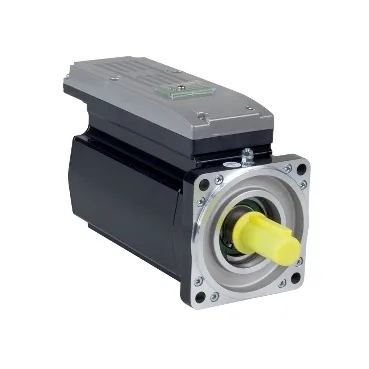
What lands on the bench when the crate opens
The ILM1003P12F0000 is a PacDrive 3 ILM-series integrated servo motor — the drive electronics sit inside the motor housing rather than in a separate cabinet, so the unit that arrives is a single flange-mounted assembly rather than a motor-and-drive pair.
Torque, speed, and the working envelope
Nominal output is 1100 W with 3.5 N·m of continuous nominal torque at 2.4 A line current; the continuous stall torque rises to 5.8 N·m at 3.6 A, and peak stall reaches 28.3 N·m for short dynamic moves, so the motor covers both steady holding duties and the accel/decel bursts that PacDrive packaging and converting lines demand. Nominal speed is 3000 rpm with a torque constant of 1.61 N·m/A at the 120 °C winding reference, and maximum Irms is 21.2 A — the figure that bounds the short-duration current the drive will command during a fast index.
Feedback, shaft, and brake
Position feedback is absolute multiturn SinCos Hiperface, so the controller knows absolute shaft position at power-on without a homing move — useful on a PacDrive machine where the reference datum must survive a power cycle. The shaft is keyed (19 mm diameter, 40 mm length, 30 mm key width) with no second shaft end, and the motor carries an integrated holding brake rated 9 N·m — sized to hold the load stationary when the servo is de-energised.
Back-EMF, inductance, and what the drive sees
Back-EMF constant is 103 V/krpm at 20 °C and stator resistance drops from 2.6 Ω phase-to-phase at 20 °C to 1.81 Ω phase-to-neutral at 120 °C — the figure that matters for I²R loss budgeting in the panel thermal envelope. Stator inductance is 15.6 mH phase-to-phase at 20 °C and 7.8 mH phase-to-neutral at 120 °C, the values the drive's current loop uses to set the switching performance.
Mounting, shaft loads, and the cabinet environment
Mounting is an international-standard flange (100 mm flange, 95 mm centring collar, 3.5 mm depth) with four 9 mm mounting holes, so the motor drops onto the standard machine footprint without an adapter plate. Shaft load limits are 1050 N radial at 1000 rpm, falling to 830 N at 2000 rpm and 730 N at 3000 rpm, with axial Fa limited to 0.2 × Fr — the values the mechanical designer uses when sizing a belt, pinion, or coupling on the output end. Cooling is natural convection and ingress protection is IP54, so the housing is sealed against dust and splash but not pressurised washdown — the cabinet or machine enclosure must keep the installation out of direct water jets.