What it slots into on a PacDrive 3 line
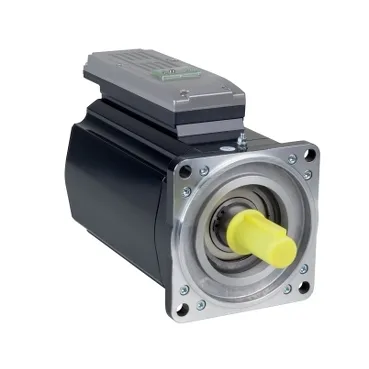
The ILM1401M02A0000 sits in the PacDrive 3 ILM family as a servo motor with an integrated drive, identified by the device short name ILM and the product line PacDrive 3 — i.e. it is the motor stage of a motion axis where the drive electronics are co-located on the back of the unit rather than mounted separately in the panel. The 140 mm flange size (5.5 in) marks it as a mid-frame axis in the range. Nominal torque is 8.3 N·m (73.5 lbf.in) with a continuous stall torque of 8.5 N·m (75.2 lbf.in) — so the motor holds its rated torque at zero speed for the steady-state clamping work a vertical or indexing axis demands. Peak stall torque is 27 N·m (239.0 lbf.in), roughly 3.2× nominal, which defines the acceleration margin available before the current clamp kicks in at maximum current Irms of 14.6 A.
Mechanical envelope and shaft-side loads
The 140 mm flange uses an international standard flange pattern with four 11 mm mounting holes on a 130 mm centring collar — drop-in compatible with the standard IEC mounting footprint a panel builder already has on the shelf. Shaft diameter is 24 mm (0.9 in) with a 50 mm (2.0 in) length and an untapped end; the second shaft end is absent, so any auxiliary encoder or hand-wheel must be coupled on the driven side of the gearbox.
Feedback, thermal, and electrical constants
Feedback is a SinCos Hiperface absolute multiturn encoder at 128 periods resolution — that is the commutation reference the integrated drive needs on first power-up, and it gives absolute position across power cycles so the axis does not have to home on every restart. Holding brake is absent, so any vertical axis relying on this motor needs an external safety brake sized to the 27 N·m peak (with the usual derate for the static holding case). Back emf constant is 175 V/krpm at 20 °C and torque constant is 2.65 N·m/A at 120 °C — together these set the DC bus headroom budget: at 1500 rpm nominal the motor generates roughly 262 V of back-EMF, which the PacDrive 3 bus must absorb or regenerate. Stator resistance moves from 4.58 Ω Ph/Ph at 20 °C to 3.18 Ω Ph/N at 120 °C (Ph/N is roughly half Ph/Ph by definition, so the 3.18 Ω figure is the per-phase-to-neutral reading) — that thermal drop is the copper-temperature telltale the drive uses for I²T protection. Line rated current is 3.15 A continuous with a continuous stall current of 3.2 A, indicating the cooling design is sized for the natural-convection case rather than a forced-air duct. IP54 protection with natural convection cooling places this motor inside the cabinet or behind a shield — not in washdown or outdoor exposure. Number of motor poles is 10, number of stacks is 1, and the 1.6 in (40 mm) key width is the standard keyseat for the 24 mm shaft. Nominal output power is 1300 W at 1500 rpm — the spec the sizing tool reads when matching this motor to the gearbox ratio and the load inertia.
Sourcing posture and what an RFQ looks like
Quotations run against the BOM quantity per RFQ: lead time and the volume ladder come back from the quote desk at request time. For project schedules, that means the ILM1401M02A0000 ships to the install date once the RFQ is closed — there is no stock-count promise carried here, just the order-to-deliver path through independent distribution. A commissioning spares package scales with the number of axes on the machine; the same order code covers the spare unit, so the BOM line stays clean for the startup spare.