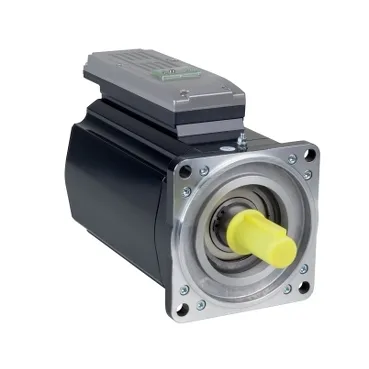
PacDrive 3 integrated servo — what this unit is
The ILM1401M01A0000 is a PacDrive 3 servo motor integrated drive (the ILM family) from Schneider Electric — meaning the drive electronics sit on the back of the motor rather than in a separate cabinet, so a junior tech wiring this for the first time only has one motor cable and one feedback line to land instead of a drive-to-motor power loop. It is built around a 140 mm flange with an international standard flange mount, four 11 mm mounting holes on a 130 mm centring collar, and an untapped 24 mm shaft that is 50 mm long with a 1.6 in (40 mm) key — a fitment that lines up with most right-angle gearheads in this frame size, and let me show you why that matters: the centring collar depth of 3.5 mm is what registers the motor square against the reducer pilot before the four through-bolts take the torque.
8.3 N·m nominal, 27 N·m peak — the torque envelope
Continuous torque is 73.5 lbf.in (8.3 N.m) nominal with a continuous stall torque of 75.2 lbf.in (8.5 N.m) — so the motor is rated to hold that figure with the shaft locked indefinitely without stepping out of its thermal envelope, which is the more honest number when you are sizing a vertical-axis hold under gravity. Peak stall torque reaches 239.0 lbf.in (27 N.m) for short accelerations, and the nominal output power of 1300 W is what the nameplate promises on a 1500 rpm duty cycle — so for a junior spec'ing a conveyor or a winder, the 8.3 N·m nominal tells you the steady-state pulling load, while the 27 N·m peak is the headroom for the start-stop transient. Behind those numbers sits a torque constant of 2.65 N.m/A at 248 °F (120 °C) winding temperature and a line-rated current of 3.15 A with a maximum Irms of 14.6 A — the peak/continuous current ratio of roughly 4.6:1 is what lets the drive push the motor to 27 N.m peak without saturating the bus, and a continuous stall current of 3.2 A confirms the rotor is built to sit at nominal torque thermally.
SinCos Hiperface at 128 periods — the feedback story
Feedback is absolute single-turn SinCos Hiperface at 128 periods of resolution, which is the single-cable encoder standard most PacDrive 3 controllers expect — that means no battery box to replace, no incremental homing routine on every power-up, and position is known the moment the bus comes up. Back EMF constant of 175 V/krpm at 68 °F (20 °C) tells you the regen voltage the drive has to swallow at top speed: a 1500 rpm nominal with the drive's bus ceiling sets the chopper sizing, while the stator figures — 4.58 Ohm Ph/Ph at 20 °C falling to 3.18 Ohm Ph/N at 120 °C, and 50 mH at 20 °C / 25 mH at 120 °C — are what the auto-tune loop reads at first switch-on, so a junior tech should not be alarmed when the controller prints a slightly different L and R after warm-up than what the cold-start log showed.
Shaft loading, IP54, natural convection — what the frame handles
Cooling is natural convection (no fan, no blower) and the protection rating is IP54 — so the motor is built for an enclosure or a sheltered machine frame, not a washdown station, and you should not expect it to shed rated torque if it is mounted in a sealed cabinet with no air movement past the housing. Ten motor poles and a single stack of laminations are what produce the smooth low-speed torque this frame is sold for — for a winder or a feed roller that wants low cogging at 50 rpm, the pole count is the reason this ILM feels better at crawl than a generic 4-pole induction alternative would.