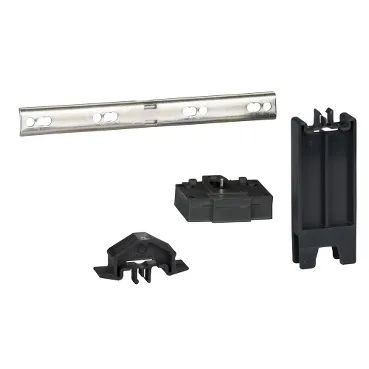
It physically prevents two contactors from closing simultaneously — a requirement for reversing motor starters, star-delta transitions, or any circuit where simultaneous energization would create a phase-to-phase short. The interlocking type is mechanical, meaning a rigid linkage between the contactor armatures blocks the opposing contactor's travel; no electrical sensing or auxiliary contacts are involved in the primary interlock function. The part accepts a 4-pole or 3-pole contactor configuration, which gives the panel builder flexibility to interlock either a full 4-pole reversing pair or a 3-pole pair with a spare pole for auxiliary wiring. It mounts between the two contactors on the DIN rail or panel plate, occupying the same footprint as the contactors themselves.
The key fit constraint is the contactor frame size: the LAEM4 is explicitly listed for LC1E80 through LC1E95 contactors. If your BOM uses LC1E38 or LC1E40 contactors, this interlock will not physically align — the mounting hole pattern and armature travel differ. The mechanical interlock is a passive device; it adds no electrical rating to the system, so the contactor's own breaking capacity, coil voltage, and auxiliary contact count remain unchanged.