Headline class and duty envelope
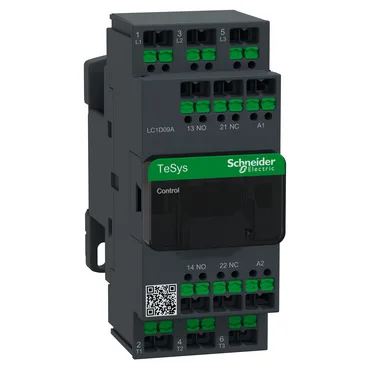
The Schneider Electric LC1D09AFE7 is a 3-pole contactor in the TeSys Deca Advanced line, listed for motor control and resistive load across AC-1, AC-3, AC-3e, and AC-4 utilisation categories. Its headline rating is 9 A on AC-3/3e at ≤440 V across motor control and resistive load duty, not a heavy-industrial contactor, but a standard pick for compact panels.
Coil, terminals, and panel-side envelope
Footprint is 86 mm deep by 45 mm wide by 107 mm tall, so it shares the LC1D frame footprint and drops into standard TeSys Deca panel layouts without re-cutting the mounting plate or gland plate. Front-face IP20 to IEC 60529 — finger-safe on the operator side once wired, with the usual caveat that the terminations themselves need shrouding for full panel IP.
Operating envelope and derating
Permissible ambient around the device is -40...60 °C, with derating required between 60 and 70 °C; the panel builder needs to size cabinet ventilation against the upper limit, not the headline 40 °C benchmark. Operating altitude is rated 0...3000 m without further compensation — covers the bulk of European and most North American sites, but anything above that needs a derate check. Mechanical robustness is 4 Gn vibration contactor closed (5...300 Hz) and 15 Gn shock closed for 11 ms, so it survives standard machine-mount cabinets and skids without a separate anti-vibration mount.
Compliance documentation
Standards coverage includes EN 60947-4-1, IEC 60947-4-1, UL 60947-4-1, CSA C22.2 No 60947-4-1, plus IEC 60335-1 Clause 30.2 and the IEC/UL 60335-2-40 Annex JJ clauses. Fire resistance is rated 850 °C to IEC 60695-2-1, and the protective treatment is TH to IEC 60068-2-30 for damp heat; climatic withstand is to IACS and IEC 60947-1 Annex Q category D, which is what the declaration pack cites for marine and offshore exposure.