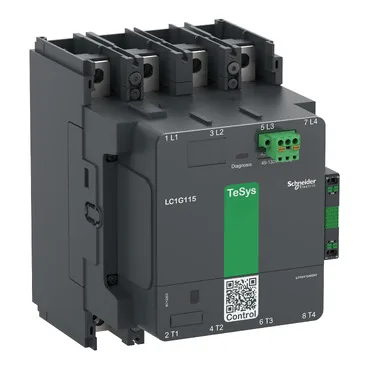
Its AC-3e rating of 75 kW at 400 V AC 50/60 Hz means it switches three-phase induction motors up to that load without welding the main contacts — the 'e' suffix indicates enhanced electrical durability for frequent starting. At 460/480 V 60 Hz it handles 100 hp, and at 575/600 V 60 Hz it handles 125 hp, making it a fit for North American motor frames as well.
The utilisation category list covers AC-1 (resistive), AC-3/AC-3e (squirrel-cage motors), AC-4 (plugging/inching), and DC-1/DC-3/DC-5 — so this contactor is not limited to motor starting; it handles resistive heating banks, DC loads, and mixed-duty panels. The 8 Mcycles mechanical durability means the actuator and spring set outlast the electrical contacts under normal switching; you replace the contact kit, not the whole device, at end of electrical life. Coil technology uses built-in bidirectional peak limiting, which suppresses voltage spikes on the control circuit — no external varistor or RC snubber needed across the coil terminals. The control circuit voltage range of 48...130 V AC 50/60 Hz and 48...130 V DC covers common control voltages in both IEC and NEMA panels, but the drop-out threshold of 0.1 Uc to 0.45 Uc at <60 °C means it releases reliably on a sagging control supply.
Plate-mounted (not DIN-rail), so it goes on a backplate or sub-panel with bolted connections. The power circuit accepts bar or busbar up to 25 x 6 mm, or lugs up to 185 mm² — sized for the 150 A frame. The 193 mm cube footprint (193 x 105 x 193 mm) is compact for a 4-pole contactor at this rating; plan for a 35 mm connection pitch between phases.
Certified to EN/IEC 60947-4-1 and 60947-5-1 (the core contactor and control-circuit standards), plus UL 60947-4-1 and CSA C22.2 No 60947-4-1 for North American acceptance. Also listed under UL 60335-1 and UL 60335-2-40 Annex JJ for household and HVAC equipment — relevant if this contactor lands in a packaged unit. The protective treatment 'TH' means it is tropicalised for humid environments.