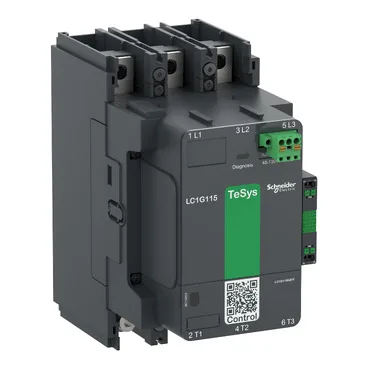
The Schneider Electric LC1G225EHES207N is a 3-pole TeSys Giga contactor rated for motor switching at 110 kW on a 400 V AC three-phase supply under AC-3e duty. That rating covers the most common European and Asian industrial motor voltages — 400 V and 415 V — so it fits directly into a standard 400 V class panel without derating. The 48-130 V AC/DC control coil gives you flexibility across control schemes: it accepts nominal 48 V, 110 V, or 120 V control circuits without needing a separate coil change. Built-in bidirectional peak limiting on the coil means you don't need an external varistor or RC snubber for most installations. The coil holds in at 0.8 Uc minimum and drops out between 0.1 and 0.45 Uc, which is a standard dropout margin for noisy industrial environments.
This is a plate-mount contactor — not DIN-rail snap-on. The 35 mm connection pitch and bolted power terminals (accepting up to 185 mm² lugs or 25 x 6 mm busbars) tell you this is sized for a motor control center or a dedicated backplate, not a crowded DIN rail. Dimensions are 193 mm deep, 108 mm wide, and 193 mm tall. The IP2X front face with shrouds meets touch-safe requirements per IEC 60529 and VDE 0106, so it can sit in a panel with the front exposed during maintenance.
The TeSys Giga family is Schneider's current-generation heavy-duty contactor platform, so replacement parts and accessories (auxiliary contact blocks, surge suppressors, mechanical interlocks) are all active and available.
The same contactor also carries AC-4 ratings (110 kW at 400 V), which covers plugging and inching duty where the motor is reversed or stopped electrically. That's a high-duty-cycle machine rate — think conveyor sortation or pump cycling, not a once-a-shift start. The B10d safety reliability figure of 400,000 cycles under nominal load (per EN/ISO 13849-1) means it can be used in safety-related control circuits up to that lifetime. Power dissipation per pole is 20 W at AC-1 (330 A thermal current) and 8 W at AC-3 (225 A). That's useful for thermal coordination in a sealed enclosure — you can calculate the cabinet heat load directly from these figures.