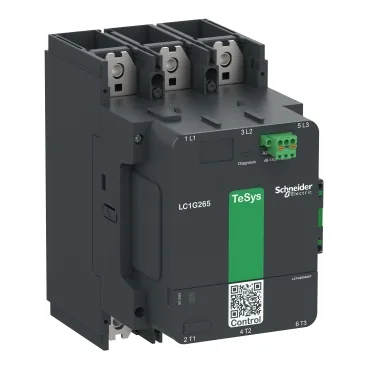
It is rated for 132 kW at 400 V AC in AC-3e duty, which is the utilisation category for standard squirrel-cage motors — meaning it handles the high inrush during starting and breaks the running current without issue. The coil accepts 48...130 V AC 50/60 Hz or 48...130 V DC, giving flexibility across control systems.
The motor power table covers the real selection decisions: 132 kW at 400 V AC-3e is the headline, but the same contactor also carries 200 kW at 690 V AC-3e and 160 kW at 1000 V AC-3e. For AC-4 duty (plugging, inching), the ratings drop to 132 kW at 400 V — a reminder that reversing or jogging loads demand a larger frame. Mechanical durability is 8 million cycles, and the maximum operating rate is 600 cycles/hour for AC-3 and AC-3e, 150 cycles/hour for AC-4. The utilisation category list (AC-1 through DC-5) means this contactor is not limited to motor starting — it handles resistive heating (AC-1), capacitor switching (AC-6a/b), and DC loads up to DC-5. The rated breaking capacity is 2380 A at 440 V, and the making capacity is 3320 A at 440 V, giving headroom for fault clearing. Power dissipation per pole is 20 W at AC-1 (385 A thermal current) and 11 W at AC-3 (265 A). That matters for enclosure thermal calculations — a panel with multiple contactors needs to account for 33 W total dissipation under motor load.
This contactor is a panel-mounted component for motor control centres, pump panels, conveyor drives, and compressor starters. It is plate-mounted (not DIN-rail), so it bolts directly to a backplate in the enclosure. The 226 mm depth and 225 mm height mean it fits standard 600 mm deep panels with clearance for wiring and ventilation.
No last-time-buy or phase-out notice applies. The control circuit voltage range (48...130 V AC/DC) is a common industrial control voltage, so it integrates with existing 110 V or 48 V control transformers.