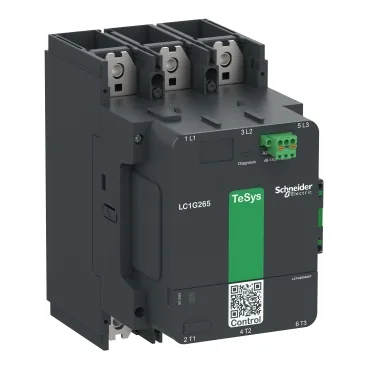
The Schneider Electric TeSys Giga LC1G400EHES207N is a 3-pole power contactor rated for heavy motor switching. In AC-3e duty — the standard for squirrel-cage motor starting — it handles 200 kW at 400 V AC 50/60 Hz, and scales up to 315 kW at 690 V. The same unit also carries AC-4 ratings for reversing or inching duty: 200 kW at 400 V, 315 kW at 690 V. That means it meets the motor load where it lives, without oversizing for the occasional plug-reverse cycle. The control circuit accepts 48-130 V AC or DC, with a built-in bidirectional peak-limiting coil technology that suppresses inrush and holds at 760 W peak. Drop-out threshold sits between 0.1 and 0.45 Uc, so it releases cleanly on a sagging control bus without chatter.
Where it fits — panel and line integration
This contactor mounts to a plate, not a DIN rail — the 225 x 226 x 140 mm envelope and 45 mm pole pitch are sized for bolted busbar or lug-ring connections. Power terminals accept bar up to 32 x 10 mm or lugs up to 185 mm². Control wiring uses push-in spring terminals on 0.2-2.5 mm² flexible or solid wire. Tightening torque on the power connections is 35 N.m — a calibrated wrench is the right tool, not an impact gun. IP2X on the front face with shrouds keeps fingers out per IEC 60529. The TH protective treatment handles damp environments. Mechanical durability is 8 million cycles; maximum operating rate hits 600 cycles/hour in AC-3 or AC-3e, 150 in AC-4. That's a contactor built for a high-duty conveyor line or a pump station cycling multiple times per minute.
Standards and compliance — what the approvals mean
This contactor carries approvals across the major global regimes: EN/IEC 60947-4-1 and 60947-5-1 for contactors and control-circuit devices, UL 60947-4-1 and CSA C22.2 No 60947-4-1 for North American installations, plus JIS C8201 for Japan. It also meets IEC 60335-1 Clause 30.2 and UL 60335-1 for appliance safety — relevant if the contactor ends up inside a packaged machine that needs a household-appliance-level glow-wire test. Overvoltage category III means it is rated for fixed-installation distribution-level surges. For safety-related circuits, the B10d values under EN/ISO 13849-1 are 400,000 cycles at nominal load and 3,000,000 cycles at mechanical load — useful data if the contactor is part of a monitored safety chain and you need to calculate the PFHd.