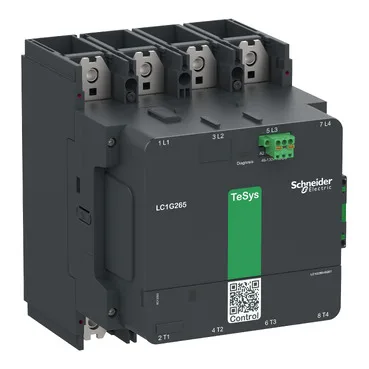
Its headline rating is 250 kW at 400 V AC in AC-3e duty, which means it handles the inrush and run current of a large induction motor — think a 400 hp pump or a 350 kW compressor at 480 V — without welding the main poles. The 48-130 V AC/DC control circuit coil uses built-in bidirectional peak limiting, so you don't need an external varistor or RC snubber on the coil supply.
The AC-3e rating at 400 V (250 kW) is the one that governs real motor switching — it's the standard for squirrel-cage motors with occasional jogging. The AC-4 rating at the same voltage (250 kW) covers reversing and inching duty where the contactor opens under full load. Mechanical durability is 8 million cycles, so this part is built for high-cycle applications like conveyor lines or press controls. The rated breaking capacity of 4600 A at 440 V and making capacity of 5090 A at 440 V give headroom for fault clearing without welding. The control circuit accepts 48-130 V AC or DC, with dropout between 0.1 and 0.45 Uc. That wide dropout band means it stays pulled in through brief voltage sags common on industrial lines. Power dissipation per pole is 40 W in AC-1 at 700 A and 20 W in AC-3 at 500 A. That matters for enclosure thermal design — a panel with four of these pulling 160 W total needs ventilation or derating above 40 °C.
This contactor mounts on a plate (not DIN rail), with a 45 mm connection pitch. Power connections are bolted — bar or busbar up to 32 x 10 mm, or lugs for 185 mm² cable. Control wiring uses push-in terminals accepting 0.2-2.5 mm² solid or 0.25-2.5 mm² flexible with ferrules. The IP2X front face with shrouds meets IEC 60529 for finger-safe installation in a panel.
The LC1G5004EHES207N carries approvals under EN/IEC 60947-4-1 (contactor standard), UL 60947-4-1, CSA C22.2 No 60947-4-1, and JIS C8201-4-1. It also meets UL 60335-1 and UL 60335-2-40 Annex JJ for appliance and HVAC applications. Overvoltage category III means it's rated for fixed-installation distribution panels.