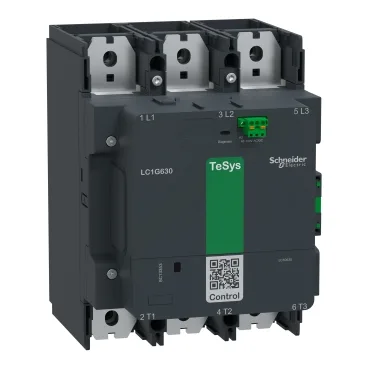
The contactor is rated across multiple utilisation categories including AC-1 (resistive), AC-3/AC-3e (squirrel-cage motor starting), AC-4 (plugging/inching), and DC-1/DC-3/DC-5 for DC loads. This breadth means it can serve as a single part number across diverse load types in a panel, reducing BOM complexity.
The 630 A rating in AC-1 (resistive) duty is the thermal current the main poles can carry continuously. The AC-4 rating of 315 kW at 400 V covers the more severe reversing or jogging duty, where the contacts must make and break locked-rotor current. For North American installations, the horsepower ratings are 600 hp at 460/480 V 60 Hz and 700 hp at 575/600 V 60 Hz. The mechanical durability is 5 million cycles, and the maximum operating rate is 600 cycles/hour for AC-3/AC-3e duty, 300 for AC-1, and 150 for AC-4. These figures set the service life and switching frequency limits for automated applications like conveyor systems or pump cycling.
Additional compliance with IEC 60335-1 Clause 30.2 and UL 60335-2-40 Annex JJ covers its use in appliance and HVAC applications where glow-wire and flammability testing is required.
Integration notes
The contactor mounts to a plate (not DIN rail) with a connection pitch of 70 mm between phases. Power connections accept bar or busbar cross-sections up to 52 x 20 mm, or lugs/ring terminals for 185 mm² cable. Tightening torque for the main connections is 58 N·m. The front face achieves IP2X with shrouds fitted. The auxiliary contact block is factory-fitted with 1 NO + 1 NC configuration. For applications requiring additional signalling or interlocking, the TeSys Giga range offers plug-in auxiliary blocks that share the same mounting footprint.