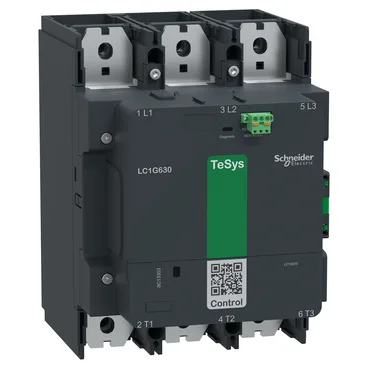
It switches motor loads up to 500 kW at 690 V AC-3 (600 hp at 460/480 V 60 Hz) and carries a thermal current (Ith) of 1050 A in AC-1 duty. The utilisation categories cover AC-1, AC-3, AC-3e, AC-4, and DC-1/3/5, so it handles resistive heating, standard squirrel-cage motors, high-inertia loads, and DC switching. Built-in bidirectional peak limiting coil technology means the control circuit handles the inrush without external suppression — the coil holds at 600 V AC/DC and draws 400 W on DC inrush. Closing time runs 40...70 ms, opening 15...50 ms.
The 630 A frame size and 500 kW at 690 V AC-3 rating tell you this contactor is sized for large motor centres, pump stations, and compressor skids on 400 V to 690 V three-phase networks. The AC-3e rating (optimised for energy-efficient IE3/IE4 motors) matches the same power levels as AC-3 but with a defined switching duty for premium-efficiency machines — a distinction that matters when the motor nameplate calls for it. Power dissipation per pole runs 70 W at Ith 1050 A (AC-1) and 26 W at 630 A (AC-3). The plate mount (not DIN rail) and bolted power connections (bar or ring terminals up to 185 mm²) mean it is built into a backplate or chassis, not snapped onto a rail. That is a high-duty-cycle machine — suitable for frequent starting applications like conveyors or crushers where the contactor cycles multiple times per minute.
Standards and safety
Certified to EN/IEC 60947-4-1 and -5-1, UL 60947-4-1, CSA C22.2 No 60947-4-1, and JIS C8201-4-1/-5-1. Overvoltage category III, IP2X front face with shrouds per IEC 60529 and VDE 0106. Safety reliability data is published: B10d = 100,000 cycles at nominal load, 1,800,000 cycles with mechanical load per EN/ISO 13849-1 — usable in safety-related control systems up to the given B10d values.
Integration notes
Dimensions are 284 mm high, 211 mm wide, 266 mm deep. Mounting is on a plate with a 70 mm connection pitch. Power circuit connections use bolted bars or ring terminals up to 185 mm²; control circuit uses push-in terminals accepting 0.2...2.5 mm² solid/stranded or 0.25...2.5 mm² flexible with ferrule. Tightening torque for power connections is 58 N·m. Auxiliary contact block comes as 1 NO + 1 NC built-in. The associated fuse recommendation is 630 A aM or 1250 A gG at the respective voltage levels — coordinate the upstream protection with the contactor's rated breaking capacity of 5550 A at 440 V and making capacity of 7220 A at 440 V.