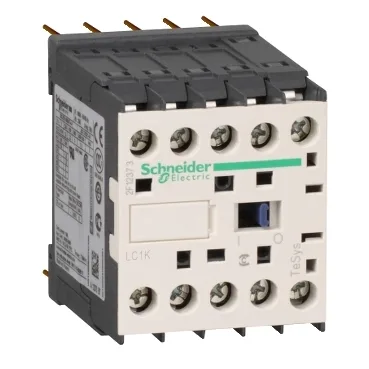
Part Overview and Lifecycle Status
The Schneider Electric TeSys K LC1K120045B7 is a 4-pole contactor (4 NO) designed for resistive load switching, rated 20 A in AC-1 utilisation category at 440 V. The coil is 24 V AC 50/60 Hz, drawing 30 VA inrush and 4.5 VA hold-in power at 20 °C. This part is classified as obsolete by the manufacturer.
The AC-1 rated operational current of 20 A at 690 V matches this for resistive loads, but the rating derates to 16 A at 70 °C ambient — a critical check for panels with tight thermal spacing. Breaking capacity is specified at 110 A at 440 V, 80 A at 500 V, and 70 A at 660–690 V per IEC 60947. This governs the contactor's ability to interrupt fault currents downstream of a 25 A gG or aM fuse (the associated fuse rating). The making capacity is 144 A AC, ensuring the contacts can close onto a short-circuit without welding. The 4 NO pole configuration (4 poles, all normally open) suits applications where all four poles switch the load simultaneously, such as three-phase resistive heating plus a neutral or a separate control circuit. The 3 mOhm average impedance per pole at 20 A keeps heat dissipation low at 1.3 W total.
Standards and Deployment Context
This contactor carries approvals to EN/IEC 60947-4-1, GB/T 14048.4, UL 60947-4-1, CSA C22.2 No 60947-4-1, and JIS C8201-4-1, making it accepted in panels destined for European, North American, Chinese, and Japanese markets. Flame retardance meets V1 per UL 94 and NF F 16-101/102 requirements for rail and building applications. Mechanical robustness is rated for shocks up to 15 Gn on Y/Z axes (closed) and 10 Gn on X axis (closed) per IEC 60068-2-27, and vibration resistance to 4 Gn at 5–300 Hz (closed). This supports mounting on machinery or in mobile equipment where shock and vibration are present. The operating altitude is 2000 m without derating, covering most industrial sites. The contactor is intended for control applications in panels and enclosures. Its dimensions of 2.2 in (57 mm) depth, 1.8 in (45 mm) width, and 2.3 in (58 mm) height fit standard DIN-rail or panel-mount footprints. The maximum operating rate of 3600 cycles per hour defines the switching duty cycle for resistive loads.