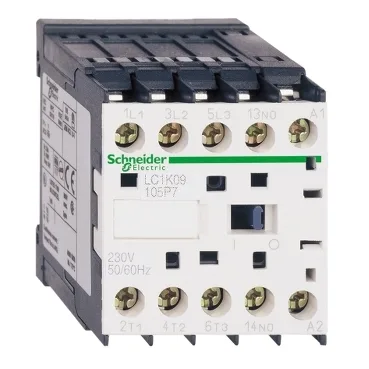
The 110 V AC 50/60 Hz coil draws 30 VA inrush and 4.5 VA hold-in, with a built-in bidirectional peak-limiting diode suppressor that clips the inductive kick — no external snubber needed on the coil circuit. It carries approvals across EN/IEC 60947-4-1, UL 60947-4-1, CSA C22.2 No 60947-4-1, and JIS C8201-4-1, so it qualifies for panels destined for North American, European, and Asian markets without a separate component-level re-certification.
For motor switching (AC-3 duty), you derate from this figure; the 20 A AC-1 rating is the resistive-load ceiling. The associated fuse recommendation of 25 A gG or 25 A aM tells you the maximum branch-circuit protection that keeps the contactor within its short-circuit withstand. Rated breaking capacity reaches 110 A at 440 V, 80 A at 500 V, and 70 A at 660–690 V — these are the fault-clearing numbers the contactor can interrupt without welding or excessive arc damage. The 144 A rated making capacity (Irms) covers the closing surge into a cold load. Mechanical robustness specs show the contactor holds closed under 10–15 Gn shocks (11 ms) and 4 Gn vibration (5–300 Hz) — relevant for machine-tool or mobile-equipment panels where the contactor sees continuous vibration.
The 45 mm wide body fits standard DIN-rail mounting in a control cabinet. Four NO poles let it switch multiple resistive loads simultaneously — heater banks, lighting groups, or as a slave contactor extending an upstream PLC output. Operating altitude is 2000 m without derating; above that, the air density drop reduces dielectric and cooling capacity, so you'd need to apply the manufacturer's altitude correction factor.