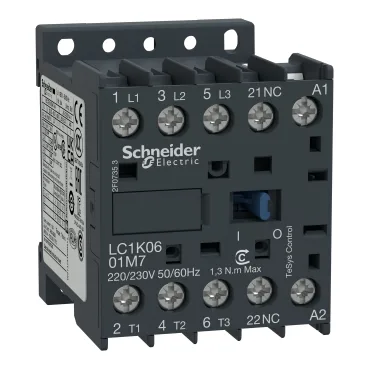
It is rated for AC-3 and AC-3e utilisation categories at 16 A up to 440 V, which means it is sized for switching three-phase induction motors in the fractional-to-small-horsepower range — the AC-3 rating governs making and breaking motor loads under running conditions, not just resistive heating. The coil is 100 V AC, 50/60 Hz, drawing 30 VA inrush and 4.5 VA holding at 20 °C, with an operating range of 0.8 to 1.15 times the control voltage and a drop-out threshold above 0.2 times Uc below 50 °C. No built-in suppressor module is fitted, so the panel builder must add external suppression (RC snubber or varistor) across the coil when the control circuit is driven by a PLC or solid-state output.
Its footprint is 45 mm wide by 58 mm high by 57 mm deep, so it occupies a single modular width on the rail. Screw-clamp terminals accept one or two conductors from 0.34 to 4 mm², solid or flexible with or without ferrules, torqued to 0.8–1.3 N·m.
The part carries multiple international approvals: EN/IEC 60947-4-1 (the main contactor standard for motor starters), UL 60947-4-1, CSA C22.2 No 60947-4-1, JIS C8201-4-1, plus GB/T 14048.4 for the Chinese market. It also complies with IEC 60335-1 Clause 30.2 and IEC 60335-2-40 Annex JJ for appliance applications. Flame-retardance is V1 per UL 94.
Sourcing decision
For a contract manufacturer or panel builder specifying this into a BOM, the key fit check is the coil voltage — 100 V AC is less common than 110/120 V AC in North American panels, so confirm the control transformer tap matches. The AC-3 rating at 16 A and 440 V covers most 3–5 HP motor starters on 400 V three-phase systems. Mechanical durability is 10 million cycles; electrical durability is 1.3 million cycles at the rated motor load.