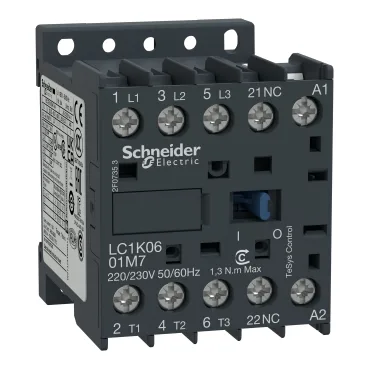
The Schneider Electric LC1K1601P5 is a TeSys K series 3-pole contactor rated 16 A in AC-3 and AC-3e utilisation categories at ≤ 440 V, with a 230 V 50 Hz coil and one normally-closed auxiliary contact. The AC-3e suffix indicates the same duty but with extended electrical endurance testing per IEC 60947-4-1. The contactor carries multi-standard approvals including EN/IEC 60947-4-1, UL 60947-4-1, CSA C22.2 No 60947-4-1, and JIS C8201-4-1, so it qualifies for panels destined for North American, European, and Japanese markets without a separate component swap. The UL 94 V-1 flame retardance rating on the housing means it self-extinguishes within 30 seconds after a flame source is removed — a standard requirement for panel-mounted equipment.
Electrical durability is rated at 1.3 million cycles at 16 A AC-3/AC-3e ≤ 440 V — that is the number of motor-start operations before the main contacts are expected to wear out under full rated load. Mechanical durability is 10 million cycles, which is the limit for the armature and spring mechanism with no load switched. The difference tells you the contacts, not the mechanics, are the life-limiting element in motor duty. The coil draws 30 VA inrush and 4.5 VA holding at 20 °C, dissipating 1.3 W continuously. The control circuit voltage limits are 0.8 to 1.15 times the rated coil voltage for pickup, and dropout occurs at ≥ 0.2 times Uc below 50 °C — so on a 230 V coil, pickup is guaranteed between 184 V and 264.5 V, and dropout happens at or above 46 V. This gives a wide brownout tolerance for control transformers feeding multiple contactors. Safety reliability is quantified with B10d values: 1,369,863 cycles under nominal load and 20,000,000 cycles under mechanical load per EN/ISO 13849-1. The minimum switching capability is 5 mA at 17 V for the signalling circuit — important if this contactor is used to switch low-level PLC inputs or pilot lights, where dry-contact reliability matters. Operating time is 10 to 20 ms for both coil energisation (NO closing) and de-energisation (NO opening). The maximum operating rate is 3600 cycles per hour, or one operation per second — sufficient for most motor starting and stopping cycles, but not for high-speed jogging or rapid reversing without derating.
The screw-clamp terminals accept one or two conductors: solid 1.5 to 4 mm², flexible without ferrule 0.75 to 4 mm², or flexible with ferrule 0.34 to 2.5 mm². Tightening torque is 0.8 to 1.3 N·m using a Philips No 2, flat 6 mm, or Pozidriv No 2 driver. The single normally-closed auxiliary contact is instantaneous — no delay built in. For applications needing additional auxiliaries or a pneumatic timer, the TeSys K range accepts add-on blocks that clip to the front or side of the contactor without tools.
The contactor withstands shocks up to 10 Gn (closed) and 6 Gn (open) on the X axis, and 15 Gn (closed) and 10 Gn (open) on Y and Z axes per IEC 60068-2-27. Vibration resistance is 4 Gn closed, 2 Gn open across 5 to 300 Hz per IEC 60068-2-6. Operating altitude is 2000 m without derating — above that, consult the thermal derating curve for the TeSys K range.