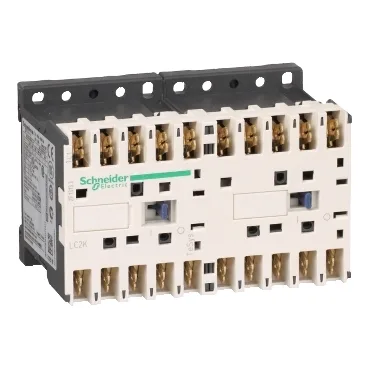
Rated AC-3 at 6 A up to 440 V, it handles reversing duty on small three-phase motors — pumps, conveyors, fans — where the contactor set switches the motor between rotation directions under load. The coil is 480 V AC, so it pulls in on a standard 480 V control transformer; verify your control voltage matches before wiring.
AC-3 at 6 A means this contactor is sized for a motor drawing about 3 A to 4 A full-load — the AC-3 rating governs switching of squirrel-cage motors during starting and plugging, not just resistive load breaking. If your motor nameplate exceeds 6 A FLA in AC-3 duty, step up to the next TeSys K frame. AC-4 capability (also listed) covers inching and jogging where the contactor opens under full motor current — that's a harder duty cycle. The 6 A AC-3 line is the practical selection anchor; AC-4 current will be lower, so don't size purely on AC-4 unless your application is all jogging. Flame retardance V1 per UL 94 and NF F 16-101/102 gives it a defined fire-smoke-toxicity profile for rail and industrial panels where material compliance matters.
Because it's current-production, the BOM line is stable: no risk of a sudden obsolescence-driven redesign. If you're freezing a panel design for a multi-year run, this contactor will be available for the foreseeable future.
The preassembled busbar saves panel space versus wiring two separate contactors with an interlock module. Mechanical shock and vibration ratings (up to 15 Gn shock, 4 Gn vibration closed) mean it holds in on high-vibration applications like compressors or mobile equipment — verify your mounting orientation matches the tested axes.