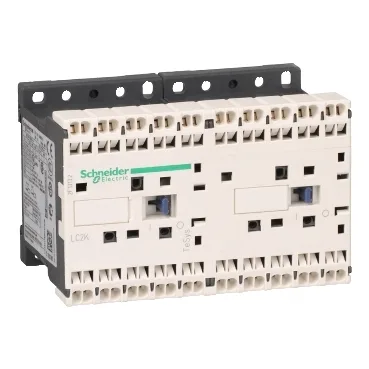
Rated 20 A in AC-1 utilisation category (resistive load) at up to 690 V, and 16 A derated at 70 °C — that resistive-duty figure is the one that governs for heater banks, lighting, or transformer primary switching where inrush isn't the limiting factor. The 48 V AC 50/60 Hz coil draws 30 VA inrush at 20 °C; holding dissipation is 1.3 W, which matters when you're counting transformer VA on a control panel that shares a small 50 VA supply with a handful of relays. Mechanical interlocking is built in — no external linkage to buy. The contactor is a changeover type, meaning the two sets of power poles are mechanically interlocked so both can't close at once, which is the core requirement for a reversing starter or automatic transfer switch.
Spring terminals accept one solid or flexible cable 0.75 to 1.5 mm² — no screw tightening, which speeds up wiring on a panel bench and eliminates the risk of a loose connection on a reversing circuit where vibration is common.
Approvals cover the major industrial markets: EN/IEC 60947-4-1, UL 60947-4-1, CSA C22.2 No 60947-4-1, and JIS C8201-4-1 — so it qualifies for panels destined for North America, Europe, and Japan without a separate special-order variant.
The 20 A AC-1 rating is for resistive loads. For motor reversing (AC-3 duty), you'd need to check the smaller AC-3 current — the part's own data shows 16 A at 690 V AC-1, but AC-3 is typically lower on the same pole set because of the inductive inrush. If you're switching a 3-phase motor, size the contactor by its AC-3 current, not the headline AC-1 figure. Breaking capacity is 110 A at 415/440 V and 80 A at 500 V — that's the fault-clearing ability of the contactor itself, not the fuse rating. The recommended upstream fuse is 25 A gG or 25 A aM, which coordinates with the contactor's withstand. Mechanical durability is 5 million cycles; electrical durability is 180,000 cycles at 20 A AC-1 at up to 440 V. For a reversing starter cycling a conveyor every 30 seconds, that electrical life translates to roughly 1,500 hours of continuous reversing — plan spares accordingly for high-duty applications.