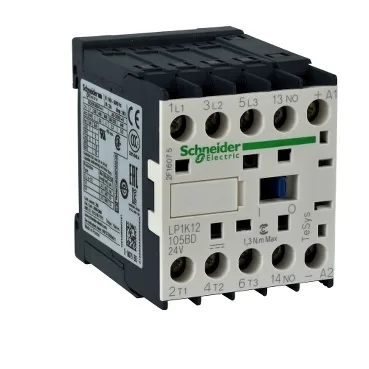
The Schneider Electric TeSys K LC7K120045B7 is a 4-pole contactor with 4 normally open (NO) main poles, controlled by a 24 V AC 50/60 Hz silent coil. It's rated for AC-1 utilisation category, meaning it's designed for resistive loads — think heater banks, lighting, or transformer primaries — not motor starting. The part mounts on printed circuit boards via solder pins, so it's a compact, board-level switching solution rather than a DIN-rail panel contactor. This contactor carries approvals across EN/IEC 60947-4-1, UL 60947-4-1, CSA C22.2 No 60947-4-1, and JIS C8201-4-1, so it's accepted in North American, European, and Japanese panels. The IP2X finger protection (per VDE 0106) means the live terminals are shielded from accidental contact — expected for a board-level component, but worth noting if it's exposed in an open chassis.
The headline rating here is the AC-1 resistive load capability: the LC7K120045B7 is rated for 20 A at up to 440 V, with an electrical durability of 0.3 million cycles at that load. That's a solid service life for a resistive-switching application — a heater or lighting contactor that cycles a few times an hour will run for years before the contacts wear out. The mechanical durability is 10 million cycles, so the mechanism itself outlasts the electrical contacts by a wide margin. The control circuit is 24 V AC at 50/60 Hz, with an inrush of 3 VA at 20 °C. The coil operates between 0.85 and 1.1 times the rated voltage, and drops out between 0.1 and 0.75 Uc. That's a standard AC coil curve — it holds in well under brownout conditions, but drops reliably when the control signal is removed. The operating time is 30 to 40 ms for closing, and 30 ms for opening, which is typical for a contactor this size. Rated insulation voltage is 600 V per UL 508 and CSA C22.2 No 14, and 690 V per IEC 60947-4-1. The rated breaking capacity is 110 A at 440 V, 80 A at 500 V, and 70 A at 660 to 690 V — these are the fault-clearing numbers, not the continuous rating. The associated fuse recommendation is 25 A gG or aM for the power circuit, so the upstream protection is sized to let the contactor do its job without nuisance tripping.
The part carries a B10d safety reliability rating of 1,369,863 cycles at nominal load per EN/ISO 13849-1, and 20 million cycles with mechanical load. That's relevant if this contactor is used in a safety-related control circuit — it gives you the data point for calculating the MTTFd in a safety function.
Integration Notes
This is a PCB-mount contactor, not a DIN-rail part. The solder pins accept a busbar cross-section of 1.5 x 0.9 mm. The heat dissipation is 3 W, so account for that in the enclosure thermal budget if it's running continuously. The maximum operating rate is 3,600 cycles per hour — one cycle per second. That's fast enough for most resistive-load cycling applications, but not for high-speed switching like a PWM load. The average impedance of the power circuit is 3 mOhm at 20 A, 50 Hz, so the voltage drop across the contacts is negligible at rated current.