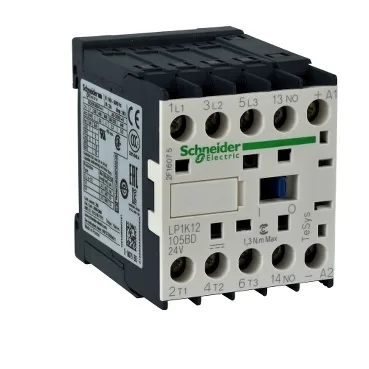
The Schneider Electric LC7K120045E7 is a TeSys K series 4-pole normally-open contactor with a 48 V AC 50/60 Hz control coil, designed for switching resistive loads in control circuits. The 4 NO pole configuration makes it suitable for switching multiple isolated load circuits simultaneously from a single coil command.
The AC-1 rating of 20 A at up to 440 V is the continuous resistive current rating; for motor loads you would need to consult the AC-3 rating of a different contactor — this unit is specified for resistive duty. Rated breaking capacity reaches 110 A at 440 V, 80 A at 500 V, and 70 A at 660–690 V per IEC 60947 — meaning it can safely interrupt fault currents at those levels, not just carry them. Electrical durability is 0.3 million cycles at 20 A AC-1, while mechanical durability is 10 million cycles — the electrical life is the limiting factor under load, so expect replacement well before the mechanical end-of-life in continuous switching applications.
Mounts on printed circuit boards via solder pins accepting a 1.5 x 0.9 mm busbar cross-section — this is a PCB-mount contactor, not a DIN-rail unit, so plan for board-level layout and solder-process compatibility. Dimensions are 57 mm deep, 45 mm wide, and 58 mm high — compact enough for dense PCB layouts but verify clearance for the 30–40 ms operating time and associated arc space.
Certified to EN/IEC 60947-4-1, UL 60947-4-1, CSA C22.2 No 60947-4-1, GB/T 14048.4, and JIS C8201-4-1 — accepted across European, North American, Chinese, and Japanese markets without additional qualification. Rated insulation voltage is 690 V per IEC 60947-4-1 and 600 V per UL 508 and CSA C22.2 No 14 — the IEC figure governs the European rating, the UL/CSA figures govern North American panel acceptance. Lifecycle status is current production — this is an active catalogue item, not a phase-out or obsolete line, so it can be specified into new designs without LTB risk.
Sourcing reality
Heat dissipation is 3 W — low enough that no forced cooling is needed in a typical enclosed panel, but account for it in thermal budgeting if multiple contactors are ganged on the same PCB.