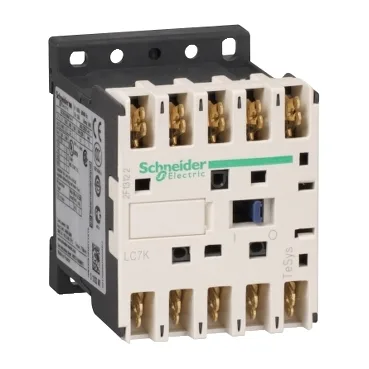
The Schneider Electric TeSys K LC7K120047B7 is a 4-pole contactor with 4 NO power poles, designed for switching resistive loads under AC-1 utilisation category. The 24 V AC 50/60 Hz coil draws a 3 VA inrush at 20 °C, with a typical operating time of 30 to 40 ms for coil energisation and NO closing, and 30 ms for de-energisation and NO opening. This puts it squarely in the control application space — think heater banks, lighting circuits, or any purely resistive load where you need a compact, panel-mount switching element.
The AC-1 rating is the headline here: this contactor is rated for resistive loads, not motor starting (that would be AC-3). The electrical durability is 0.3 Mcycles at 20 A AC-1 at Ue ≤ 440 V, while mechanical durability hits 10 Mcycles — so the contacts will wear out long before the mechanism does, which is typical for a contactor in this class. The rated breaking capacity is 110 A at 440 V, 80 A at 500 V, and 70 A at 660 to 690 V per IEC 60947, so it can interrupt a fault on a resistive circuit up to those levels. The associated fuse rating is 25 A gG or 25 A aM for the power circuit — that's your upstream protection guide. The control circuit is 24 V AC at 50/60 Hz, with an operational range of 0.85 to 1.1 Uc and a drop-out range of 0.1 to 0.75 Uc at <50 °C. That means it will pick up reliably at about 20.4 V AC and drop out somewhere between 2.4 and 18 V AC, depending on temperature. The coil is the 'silent' type — no audible hum at line frequency, which matters if the panel is in an office or quiet environment. Rated insulation voltage is 600 V per UL 508 and CSA C22.2 No 14, and 690 V per IEC 60947-4-1, so it's comfortable in 480 V or 600 V class panels. The IP2X finger protection per VDE 0106 is a basic touch-safe rating — enough for a closed panel, not for open or wet locations.
The footprint is 45 mm wide, 58 mm high, and 57 mm deep — a compact 4-pole block that fits standard 45 mm per-pole spacing on the rail. Connections are Faston terminals: two cables on a 2.8 mm busbar or one cable on a 6.35 mm busbar. That's a push-on tab arrangement, common in panel wiring for this class of contactor.
Mechanical and environmental robustness
Rated for shock and vibration per IEC 60068-2-27 and IEC 60068-2-6. With the contactor closed, it handles 10 Gn on the X axis and 15 Gn on Y and Z axes for 11 ms shocks; open, it's 6 Gn on X and 10 Gn on Y and Z. Vibration resistance is 4 Gn closed and 2 Gn open across 5 to 300 Hz. That's enough for most industrial machinery, including conveyors and pumps. Operating altitude is 2000 m without derating. Protective treatment is TC per IEC 60068 and DIN 50016, which covers tropical climate resistance — so it's fine in humid or warm environments without additional conformal coating.
Safety and reliability data
For safety circuit integration, the B10d value is 1,369,863 cycles with nominal load per EN/ISO 13849-1, and 20,000,000 cycles with mechanical load. That gives you a data point for calculating the MTTFd in a safety-related control system. The maximum operating rate is 3600 cycles per hour — one per second — so it's fine for rapid cycling in resistive load applications like oven or furnace control.