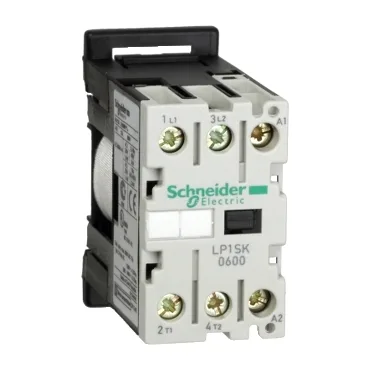
The LP1SK0600SD is a TeSys SK mini contactor from Schneider Electric, built as a 2-pole normally-open (2 NO) device. It's rated for resistive loads in AC-1 utilisation category, carrying 12 A continuously at up to 690 V AC. The coil is 72 V DC, so it fits control circuits that run on a DC bus — common in panel designs where you want to avoid AC hum and keep the coil suppression simple.
The 12 A AC-1 rating is the continuous resistive current it can switch — think heaters, ovens, or lamp banks. That's not a motor rating; AC-3 (motor) current would be lower, so if you're switching an induction motor, this isn't the contactor for that job. Coil pickup is 8...12 ms, dropout is 4...6 ms — fast enough for most sequencing but not a high-speed application. The control voltage limits are 0.85...1.1 Uc for operation and 0.1...0.75 Uc for dropout at <50 °C, so the 72 V coil holds in down to about 61 V and drops out below about 54 V. That's a standard DC margin; just ensure your supply stays above 61 V under load. That's fine for on/off control of a resistive load in a process line, but not for PWM or fast cycling like a welding gun.
It snaps onto a DIN rail (35 mm), and the footprint is 27 mm wide by 56 mm tall by 55.5 mm deep — a compact 2-pole block that fits in a crowded enclosure. The IP2X protection (finger-safe) means it's fine inside a panel but not for exposed mounting. Wire termination is via screw connectors: accepts 0.35...6 mm² solid or flexible (with/without ferrule), and up to two conductors per terminal for daisy-chaining. Tightening torque is 0.8 N.m with a Pozidriv No 1 bit. Heat dissipation is 2.2 W at 20 °C — negligible in a ventilated panel, but worth noting if you're packing dozens of these in a sealed enclosure. The operating temperature range is -20...50 °C, storage is -50...70 °C, and it's rated for 2000 m altitude without derating.