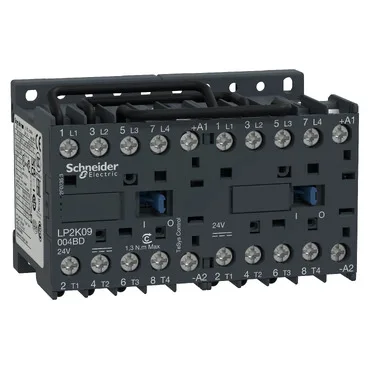
Rated in utilisation category AC-1, it is designed for resistive loads — think heater banks, lighting, or transformer primary switching — where the current waveform stays near sinusoidal and contact erosion from inrush is minimal. The 110 V DC coil pulls 3 W at 20 °C to hold in, with an operating range of 0.8 to 1.15 Uc and a drop-out band of 0.1 to 0.75 Uc below 50 °C, so it stays picked through brownout conditions but drops cleanly when the control signal is removed.
Breaking capacity is listed per IEC 60947 across multiple voltage points: 110 A at 415 V and 440 V, 80 A at 500 V, 70 A at 660–690 V. Electrical durability is 0.18 Mcycles at 20 A, AC-1, up to 440 V. That is about 180,000 operations at rated resistive load — enough for a moderate-duty cycling application. Mechanical durability is 5 Mcycles, so the mechanism outlasts the electrical contacts by a wide margin; plan contact inspection around the electrical life figure. Safety reliability is quantified with a B10d of 1,369,863 cycles at nominal load and 20,000,000 cycles at mechanical load per EN/ISO 13849-1 — useful if this contactor sits in a safety-related control circuit where you need to calculate the probability of dangerous failure per channel. Mounts on a rail or plate — the DIN-rail clip is standard for panel integration, and the screw-clamp terminals accept 0.34 to 4 mm² flexible or solid wire, with a tightening torque of 0.8 to 1.3 N·m using a No. 2 Phillips or 6 mm flat blade.
No special minimums or custom-manufacturing lead times apply.