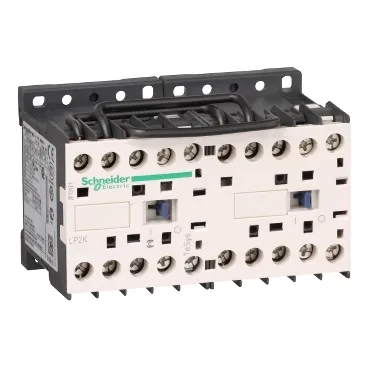
The mechanical interlock between the two contactor halves is built in, which saves panel space and eliminates the risk of a mis-wired external interlock that could let both coils pull in at once. Rated for AC-1 resistive loads, it handles 20 A continuously through the power poles. The 250 VDC coil includes a built-in bidirectional peak-limiting diode suppressor, so you don't need to add a separate flyback diode or RC snubber across the coil — just wire the DC supply and go. Heat dissipation is 3 W at 20 °C, which is modest enough that several of these can sit side by side on a DIN rail without cooking the adjacent devices.
The 4-pole configuration (4P) means this contactor switches four power circuits simultaneously — typical for three-phase reversing plus a neutral, or for two independent loads that need coordinated switching. The 250 VDC coil is a specific control voltage; verify your control transformer or DC supply matches that nominal voltage, because the coil hold range is 0.8 to 1.15 Uc (200 to 287.5 VDC) and dropout is 0.1 to 0.75 Uc (25 to 187.5 VDC). If your control bus is 24 VDC or 110 VDC, this is not the right coil variant. Rated breaking capacity is 110 A at 440 V, 80 A at 500 V, and 70 A at 660–690 V per IEC 60947. That's the fault-clearing ability of the contactor itself — it can interrupt a short-circuit current up to those levels, but the upstream fuse (25 A gG or 25 A aM, as associated) must be sized to protect the contactor from exceeding its withstand. The average impedance of the power circuit is 3 mΩ at 20 A, 50 Hz, which keeps voltage drop negligible in a 20 A resistive circuit. Mechanical durability is rated at 5 million cycles, and electrical durability at 0.3 million cycles under AC-1 at 20 A, ≤440 V. The B10d safety reliability figure is 1,369,863 cycles at nominal load per EN/ISO 13849-1, which is relevant if this contactor is used in a safety-related control circuit.
Mounts on a rail or plate — the 57 mm depth, 90 mm width, and 58 mm height fit the standard TeSys K footprint. Screw clamp terminals accept one or two conductors: solid 1.5–4 mm², flexible without ferrule 0.75–4 mm², or flexible with ferrule 0.34–2.5 mm². Tightening torque is 1.3 N·m using a Philips No. 2 or flat 6 mm screwdriver.