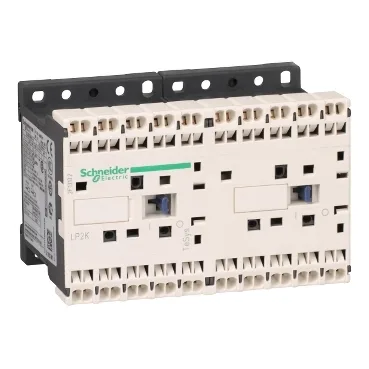
Rated AC-3 at 12 A up to 440 V, it handles reversing duty on small three-phase motors. The 48 V DC coil keeps control-circuit isolation clean.
This part is marked obsolete by Schneider Electric. The TeSys K family is mature; if you are qualifying a replacement, the closest functional fit will be a current TeSys Deca or TeSys F reversing contactor with matching coil voltage and pole count, but pinout and mounting dimensions differ — verify the mechanical interface before committing a panel revision.
AC-3 means it makes and breaks motor inrush (typically 6–8× FLA) and interrupts the stalled-rotor current. The 48 V DC coil draws roughly 0.2 A steady-state; verify your control transformer or power supply can deliver the inrush peak (about 4× holding current for 50 ms). IP20 means finger-safe terminals but no protection against water ingress — mount inside a panel rated for the environment. The 57 mm depth fits standard 45 mm DIN-rail enclosures with clearance for wiring ducts.
Altitude derating kicks in above 2000 m — no change needed for most sites. Vibration resistance: 4 Gn closed, 2 Gn open across 5–300 Hz. Shock: 15 Gn closed on Z axis, 10 Gn open. Flame retardance meets UL 94 V-1 and NF F 16-101/102, which covers rail and industrial panel fire-safety requirements. The protective treatment (TC per IEC 60068 and DIN 50016) indicates basic corrosion resistance for indoor controlled environments.