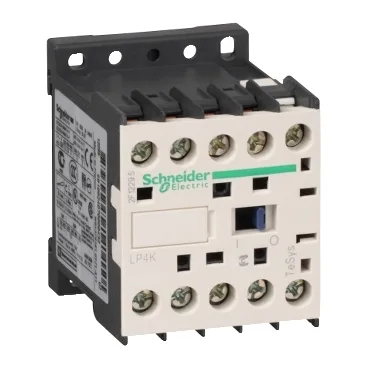
The Schneider Electric LP4K09004FW3 is a TeSys K 4-pole contactor with four normally-open power poles, rated for 20 A AC-1 at 440 V and controlled by a 110 VDC coil. The AC-1 utilisation category means this contactor is specified for resistive loads — heaters, lighting banks, or other non-inductive circuits where the current waveform stays close to sinusoidal and inrush is minimal. The coil draws 1.8 W holding power and includes a built-in bidirectional peak-limiting diode suppressor, which simplifies panel wiring by eliminating the need for an external flyback diode across the coil terminals. Operating time is 30–40 ms for coil energisation and NO closing, and 10 ms for coil de-energisation and NO opening — fast enough for most sequencing and interlocking schemes in a control panel.
Screw-clamp terminals accept Philips No. 2 or flat 6 mm screwdrivers at 1.3 Nm torque. The 4 NO pole configuration means it switches four independent resistive circuits simultaneously, or can be wired as a single-pole device with the poles paralleled for higher current capacity — though the 20 A Ith per pole is the limit regardless of paralleling.
Certified to EN/IEC 60947-4-1, UL 60947-4-1, CSA C22.2 No. 60947-4-1, GB/T 14048.4, and JIS C8201-4-1 — covers the major global markets for contactor standards. Rated insulation voltage (Ui) is 690 V per IEC 60947-4-1 and 600 V per UL 508 / CSA C22.2 No. 14, so it is suitable for 480 V and 600 V class systems within those limits. Impulse withstand voltage is 8 kV, overvoltage category III, which is standard for fixed-installation industrial control panels. Flame retardance meets V1 per UL 94 and NF F 16-101/102 requirements.
Mechanical and electrical endurance
Rated for 30 million mechanical cycles and a maximum operating rate of 3600 cycles per hour — suitable for high-duty applications like resistance welding controls or cyclic heater switching where the contactor cycles many times per shift. Safety reliability is quantified with B10d values: 1,369,863 cycles under nominal resistive load and 20,000,000 cycles under mechanical load only, per EN/ISO 13849-1. These figures let a safety engineer calculate the PFHd contribution of this contactor in a safety-related control system.