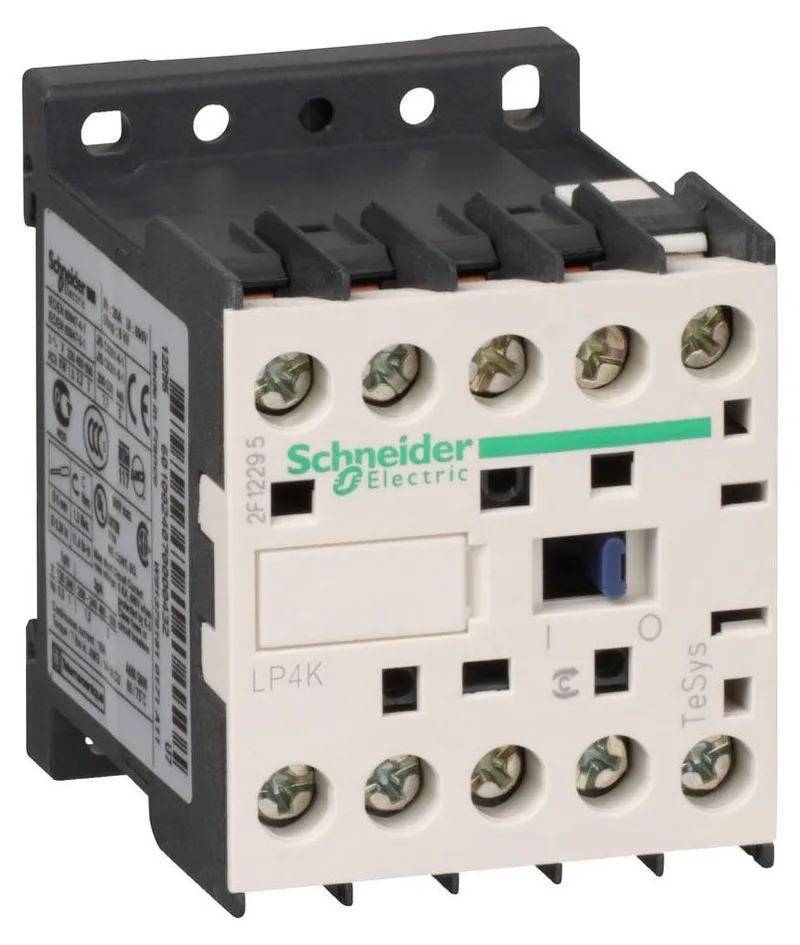
The Schneider Electric TeSys LP4K09008EW3 is a 4-pole contactor rated for 20 A in AC-1 resistive duty at up to 690 V, with a 48 V DC coil that includes an integral suppression device. It ships as a current-production unit (TeSys range) for panel builders needing a compact, high-cycle resistive load switch. AC-1 covers resistive loads like heaters, lighting banks, and industrial furnaces. Do not use this contactor at the 20 A level for motor starting (AC-3) – that would require a larger TeSys frame. The 3 mOhm average impedance in the power circuit keeps voltage drop minimal at rated current. Mechanical durability is 30 million cycles, but electrical endurance at rated load is 0.16 million cycles – the contact wear from breaking resistive current governs replacement intervals, not the mechanical mechanism.
Coil and control specifics
Operating times: NO closing in 30–40 ms, opening in 10–20 ms after coil de-energisation. NC poles are slightly slower to close (25–35 ms) and faster to open (15–25 ms). That asymmetry matters if you're sequencing interlocked loads. Maximum operating rate is 3600 cycles per hour – enough for frequent on/off control of resistive banks without derating.
Screw clamp terminals accept 1.5–4 mm² solid or 0.75–4 mm² flexible wire (with or without ferrules). Tightening torque: 0.8–1.3 N·m; use a Pozidriv No. 2, Philips No. 2, or flat Ø 6 mm bit. IP2X finger-safe front panel. Associated fuse rating for the power circuit is 25 A gG or 25 A aM. Breaking capacity is 110 A AC up to 440 V, tapering to 70 A at 690 V – coordination with upstream protection is straightforward.
Compliance and sourcing posture
Listed to UL 60947-4-1 and -5-1, IEC 60947-4-1/5-1, CSA C22.2 No. 60947-4-1, and GB/T 14048.4. Flame retardance meets UL 94 V1 and NF F 16-101/102. Overvoltage category III. The lifecycle is current – no last-time-buy pressure. Source against your BOM via a standard RFQ.