Obsolete — what that means for your BOM
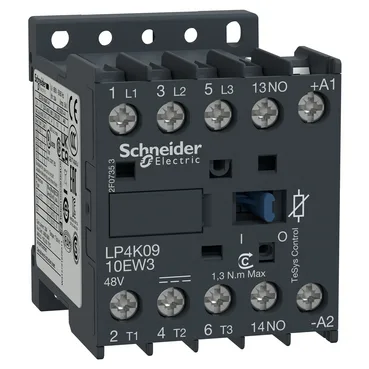
Schneider lists the LP4K0910EW3 as obsolete. The part is sourced through independent distribution against an RFQ — quantities and pricing confirmed at quote time, not held as shelf stock.
9 A AC-3 duty — the rating that decides fit
AC-3 is the standard for squirrel-cage motor switching — starting and disconnecting under load. The 9 A figure governs the motor FLA it can handle; for a 400 V three-phase motor, that typically covers up to about 4 kW, depending on the motor efficiency and duty cycle. Electrical endurance is 1.3 million cycles at 9 A AC-3. Mechanical endurance is 30 million cycles. The maximum operating rate is 3600 cycles per hour, which suits high-speed pick-and-place or packaging machinery where the contactor cycles every second.
48 V DC low-consumption coil — why it matters
The coil is 48 V DC with an integrated suppression diode. Hold-in power is 1.8 W at 20 °C, and the inrush is also 1.8 W — no current spike on pull-in, which simplifies the DC supply sizing. The control voltage limits are 0.7 to 1.3 Uc for operation and ≥0.1 Uc for drop-out at 50 °C. That wide drop-out margin means the contactor releases reliably even if the DC bus sags during a brownout. Coil de-energisation and NO opening takes 10 to 20 ms; energisation and NO closing takes 30 to 40 ms. The 1 NO auxiliary contact is instantaneous, so it switches at the same speed as the main poles — useful for feedback to a PLC or for interlocking another contactor.
Mounts on DIN rail or plate. Dimensions are 2.2 in (57 mm) deep, 1.8 in (45 mm) wide, 2.3 in (58 mm) high — a compact footprint that fits a standard 45 mm-wide slot on the rail. Screw-clamp terminals accept solid wire from 1.5 to 4 mm² and flexible wire with ferrule from 0.34 to 2.5 mm². Tightening torque is 0.8 to 1.3 N·m. IP2X finger protection — safe for open-panel mounting where operators might reach in. Flame retardance is V1 per UL 94 and meets NF F 16-101/102 requirement 2, which is the French rail standard for fire behaviour.
Standards and safety reliability
That covers the main contactor standard (part 4-1) and the control-circuit device standard (part 5-1) — so it is accepted in North American, European, and Chinese panels. Safety reliability is quantified per EN/ISO 13849-1: B10d = 1,369,863 cycles with nominal load, and B10d = 20,000,000 cycles with mechanical load only. That B10d figure feeds into the PFHd calculation for a safety-related control system — useful if this contactor is part of a safety circuit that must meet a given SIL or PL target.