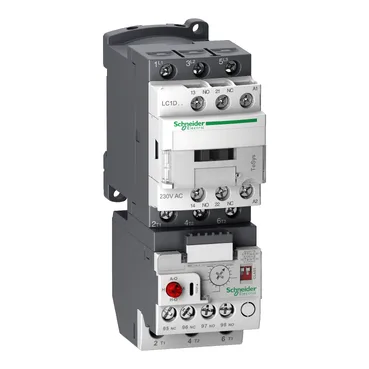
It's designed for three-phase motor control in the 1.1 to 6 kW range depending on supply voltage (200–500 V). The thermal overload is adjustable from Class 5 to Class 30, so you can match the trip curve to the motor's starting profile — fast for low-inertia pumps, slower for high-inertia fans or conveyors.
The motor power range is voltage-dependent: 1.1–2 kW on 200–240 V, 2.2–3 kW on 380–440 V, and 4–6 kW on 480–500 V. That 6 kW ceiling at 480 V tells you this is a compact unit sized for smaller machines — think conveyors, small compressors, or fan drives — not a 50 hp main drive. The utilisation categories cover AC-1 (resistive loads), AC-3 (squirrel-cage motors), and AC-4 (plugging/inching duty), so it handles both normal running and frequent reversing or jogging. The adjustable trip class (5 through 30) lets you dial in the overload response. Class 10 is the default for most standard motors; Class 20 or 30 buys you more time during high-inertia starts without nuisance tripping. The white dial on the front sets the full-load current, and the red knob selects automatic or manual reset after a trip — handy for remote or unattended installations where you don't want someone pressing a button every time. Front face is IP20 (finger-safe), but the unit itself is meant for inside a panel — not washdown or outdoor. The 6 kV dielectric strength and 1000 V rated insulation voltage on the power circuit give solid margin for 480 V systems.
This part carries UL 60947-4-1, CSA C22.2, and IEC 60947-4-1 approvals — the key standards for motor starters in North America and internationally. It also meets GB 14048.4 for the Chinese market. The TH protective treatment per IEC 60068-2-30 means it's tested for damp heat, cyclic — relevant if the panel sees humidity swings.