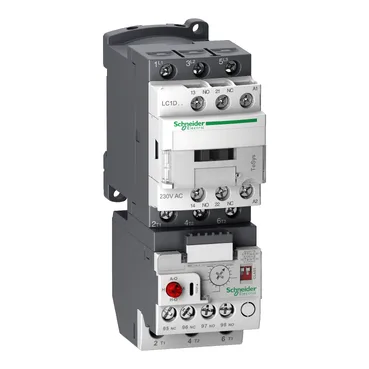
The Schneider Electric TeSys LR9D32KITD12BD is a direct on-line motor starter combining a contactor and thermal overload relay in one unit, sized for 4-6 kW three-phase motors at 380-440 V (also covers 4-6 kW at 480-500 V and 2.2-3 kW at 200-240 V). It's a 3-pole device with three normally-open power poles, designed for AC-3 (motor start/run) and AC-4 (plugging/reversing) duty, plus AC-1 resistive loads. The thermal overload adjustment covers Class 5 through Class 30 trip curves, with a tripping threshold of 1.25 × In per IEC 60947-4-1. The automatic reset time is factory-set at 1.5 to 4 minutes — useful for remote or unattended restart applications where manual reset isn't practical.
The 4-6 kW motor power range at 380-440 V is the headline selection parameter — this part fits a 5.5 kW (7.5 HP) motor on a 400 V line. The Class 5-30 overload adjustment means you can set the trip curve to match motor thermal time constants from fast (Class 5, for submersible pumps) to slow (Class 30, for high-inertia loads like fans or centrifuges). The 1.25 In tripping threshold is the standard motor-protection pickup; it allows the motor to draw 125% of its FLA briefly before the overload element starts timing out. The 24 V DC coil (300 mW consumption) is standard for PLC-driven control panels — no extra power supply needed if your cabinet already runs 24 VDC.
Mounts under a contactor plate or on DIN rail with specific accessories — typical for TeSys D-series panel layouts. The screw-clamp terminals accept up to 16 mm² power wiring and 2.5 mm² control wiring, with tightening torques of 3.1 N·m (power) and 0.8 N·m (control). Dimensions are 2.9 in (72.5 mm) high, 1.8 in (45 mm) wide, and 3.1 in (79.9 mm) deep — a compact footprint that fits standard 45 mm-wide DIN-rail slots. Operating altitude is 2000 m without derating; above that, the dielectric strength and thermal dissipation need to be recalculated.
Listed to UL 60947-4-1, IEC 60947-4-1, CSA C22.2, and GB 14048.4 — the key standards for motor starters in North America and internationally. Flame retardance is V1 per UL 94, and glow-wire resistance is 850 °C per IEC 60695-2-1. Electromagnetic compatibility includes surge withstand at 2 kV common mode (IEC 61000-4-5), electrostatic discharge immunity at 8 kV (IEC 61000-4-2), radiated RF immunity at 10 V/m (IEC 61000-4-3), and fast transient immunity at 2 kV (IEC 61000-4-4). The protective treatment is TH per IEC 60068-2-30, meaning it's tested for damp heat cycling.