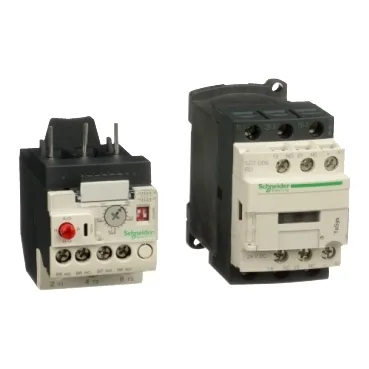
The Schneider LR9D08KITD09BD is a TeSys thermal overload relay — a 3-pole direct-on-line motor starter component that protects motors against overload and phase-loss conditions. It mounts under a contactor (or on a rail with specific accessories) and is rated for motor power ranges from 1.1 kW up to 6 kW depending on supply voltage (200–500 V three-phase). The adjustable trip class (Class 5 through 30) lets you match the relay's thermal curve to the motor's starting profile — faster for low-inertia loads, slower for high-inertia starts. The front face carries a red push-button for stop and manual reset, a white dial for full-load current adjustment, and a red knob for automatic reset mode. Two microswitches handle the signalling circuit. The automatic reset time is fixed at 1.5 to 4 minutes, which matters for applications where you want the motor to restart without an operator visit after a trip.
The motor power range covers 1.1–2 kW at 200–240 V, 2.2–3 kW at 380–440 V, 4–6 kW at 380–440 V, and 4–6 kW at 480–500 V three-phase. That means the same relay body handles a wide voltage spread — useful if your line runs mixed motor voltages. The utilisation categories include AC-1 (resistive), AC-3 (squirrel-cage motor starting), and AC-4 (plugging/inching), so it's not limited to simple starting duty. The tripping threshold is 1.25 × In per IEC 60947-4-1. The dielectric strength is 6 kV at 50 Hz (IEC 60255-5). The front face is IP20 (IEC 60529) — finger-safe but not washdown-rated.
For compliance documentation, the brand provides RoHS and REACH declarations as standard for the TeSys range, plus the UL/CSA/IEC certificates listed above. No PCN or EOL notice is on record for this order code.
Mounting options: under a contactor via a plate, or on a DIN rail with specific accessories. The power circuit terminals accept up to 16 mm² solid or flexible wire (no cable end), torqued to 3.1 N·m. Control circuit terminals accept 2.5 mm² at 0.8 N·m. The associated fuse rating for the signalling circuit is 5 A (gG or BS type). Dimensions: 3.1 in (79.9 mm) deep, 1.8 in (45 mm) wide, 2.9 in (72.5 mm) tall. The compact width means it fits in a standard 45 mm slot on a DIN-rail assembly, leaving room for adjacent contactors or auxiliaries.