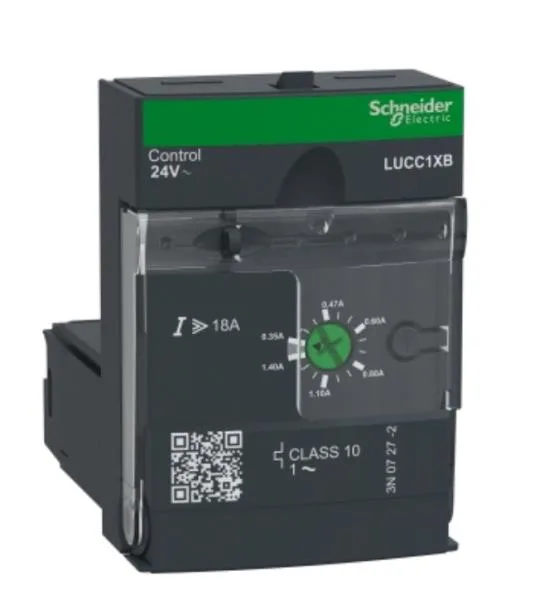
The Schneider LUCC1XB is the brains of a TeSys Ultra motor controller — an advanced control unit that handles basic protection (overload, short-circuit, phase failure, earth fault) and can report status over a communication link. It’s the part that sits between your contactor and the motor, watching current and tripping when things go sideways. This one is wired for a single‑phase motor, with a manual reset button to clear a trip once the fault is fixed. No automatic restart — you have to go look at it, which anybody who’s cleared a jammed conveyor likes.
It’s only 60 mm deep, 45 mm wide, 66 mm tall — slim enough to fit in a shallow sub‑panel or a wall‑mounted enclosure where every inch of gland space matters. IP20 on the front face, IP40 on the other faces, so it’s fine behind a panel door without an extra cover. Rated for 0.09 kW at 400–440 V AC, 50/60 Hz on a single‑phase motor. The trip threshold is adjustable to 14.2× Ir ±20 %, so you can set it for a motor with a high inrush if needed. It plugs into the front face of the TeSys Ultra contactor — no wiring between them, just push it on. That means a blown control unit can be swapped quickly without touching the power wiring.
Control voltage and power draw
Control voltage is 24 V AC. While closing, it draws 140 mA with the standard LUB12 coil, 220 mA with the LUB32 or LUB38. Sealed, it drops to 70 mA or 90 mA, depending which coil you’re using. That 2–3 W heat dissipation needs to be accounted for in a dense panel — don’t box it in with 20 other heat sources. Opening time is 35 ms, closing 70 ms — fast enough for most motor protection schemes, but not suitable for high‑speed cycling. Immunity to micro‑breaks is 3 ms, so it won’t trip on a brief voltage sag, but a 70 % dip lasting 500 ms will drop it out.
Compliance and reach
Listed under IEC 60947‑6‑2, UL 60947‑4‑1, and CSA C22.2 No. 60947‑4‑1 (with the phase barrier). That covers most industrial installations in North America and Europe. No special documentation gymnastics — it’s a standard catalog item. Production status is current — no phase‑out or NRND notice. You can quote it into a BOM freeze without worrying about a last‑time‑buy window closing next quarter.