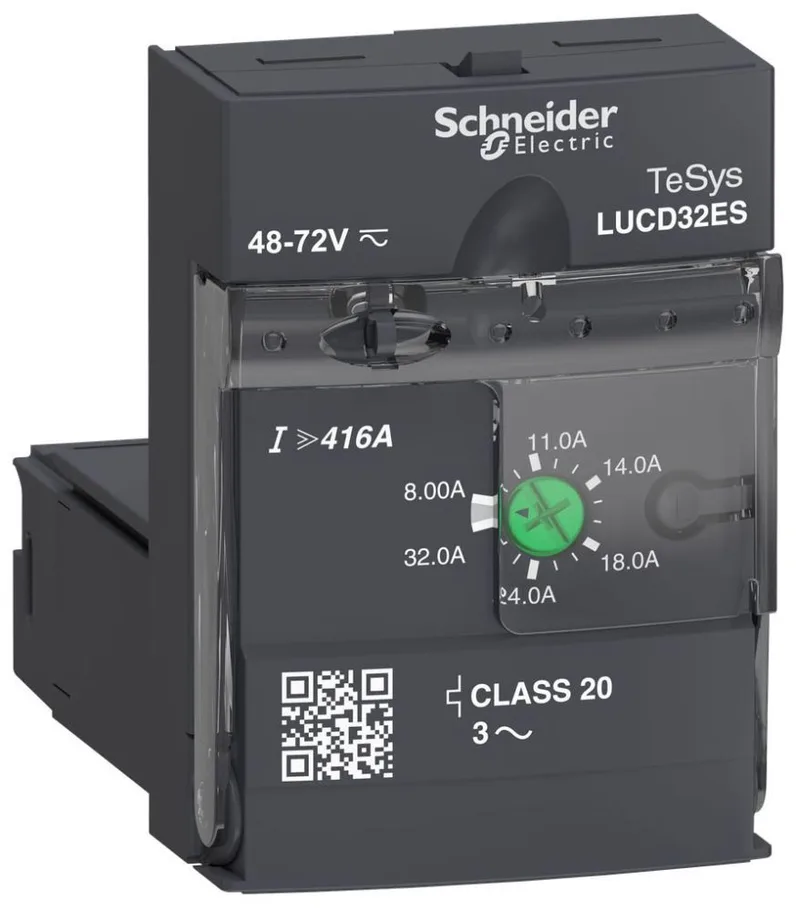
Advanced Control Unit for TeSys Ultra
The LUCD32ES is an advanced control unit from the TeSys Ultra range, designed to plug into the front of a TeSys contactor base. It provides intelligent motor protection and control: overload, short-circuit, earth fault, and phase failure detection are all built in, with a manual reset after a trip. Let me show you why this part stands out for new panels and retrofits alike. Control voltage is 48 V AC or 48...72 V DC – a single supply covers both. When the coil closes, it pulls 280 mA momentarily; once sealed, the sustained draw drops to 45 mA (rms). That sealed current is low enough that you don't need an oversized power supply on the control transformer. Utilization categories AC-41, AC-43, and AC-44 tell you this unit is rated for motor switching, not just resistive loads. It works with three-phase self-cooled motors up to 18.5 kW at 690 V AC (50/60 Hz). The thermal overload class is 20, which matches typical motor startup duty. A trip threshold of 14.2 x Ir (+/-20%) handles short-circuit peaks before the contactor opens within 35 ms via a LUB32 or LUB38 control circuit.
Protection Coverage and Environmental Ratings
The LUCD32ES covers the main motor fault modes: protection against overload, short-circuit, earth fault, phase failure, and phase imbalance. That is a lot of functionality in a package that measures 2.6 in high, 1.8 in wide, and 2.4 in deep (66 x 45 x 60 mm). It is certified to IEC 60947-6-2, UL 60947-4-1, and CSA C22.2 No 60947-4-1 (both with phase barrier). If you are building a panel that needs a UL mark, this unit has the listing. The shock and vibration resistance are solid: 10 gn with poles open, 15 gn with poles closed, and 4 gn vibration (5-300 Hz) when closed. Fire resistance is rated at 1760 °F (960 °C) for parts supporting live components.
Mounting is a simple front-face plug-in onto the TeSys contactor base – no extra DIN rail space needed. The wiring terminals are accessible from the front, and the IP20 rating on those terminals means you can reach in without full isolation as long as the panel is de-energised (standard practice). Safe separation is provided: the control and auxiliary circuits are isolated at 400 V SELV from each other and from the main circuit (IEC 60947-1). If you are connecting a PLC output directly, watch the max sealed current of 45 mA – most digital outputs can handle that, but verify the sink capability. Immunity to microbreaks is 3 ms, so short power dips won't cause nuisance trips.