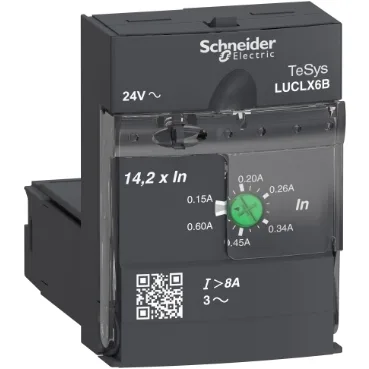
The Schneider TeSys Ultra LUCLX6B is a magnetic control unit — the brain of a motor starter that handles the coil logic and protection curve for a 3-phase motor. It's rated for 0.09 kW at 400...440 V AC 50/60 Hz, which puts it at the low end of the power range, sized for small pumps, fans, or conveyor drives. The 24 V AC control circuit keeps it compatible with standard control transformers in most panels. What sets this part apart is its AC-44 utilisation category — that's the heavy-duty switching class for motors with frequent starting and plugging (reverse braking). Most general-purpose contactors are AC-3; AC-44 means the LUCLX6B is built for the higher electrical stress of reversing or inching duty, where the contacts see repeated inrush without the benefit of a clean break. If your application involves jogging, reversing conveyors, or crane travel drives, this is the category that matters. It's also specifically listed for protection of variable speed drives and soft-start/soft-stop units, not just direct-on-line motors. That means the trip curve and isolation coordination are tuned for the harmonic-rich, non-sinusoidal waveforms a VFD produces — a detail that generic motor starters often miss.
The tripping threshold is 14.2 x Ir ± 20%. Opening time is 35 ms with the matching LUB control module. The plug-in front face mounting means the LUCLX6B clips onto a DIN-rail-mounted base — typically the TeSys Ultra LUB series control modules. This is a modular architecture: the control unit swaps without disturbing the power wiring, which cuts replacement time on a live panel to seconds. The 45 mm width and 66 mm height keep it to a single 45 mm modular pitch on the rail.
That covers North American and European installations without a separate approval hunt. The TH protective treatment per IEC 60068 means it's built for tropical/humid environments — not just dry indoor panels.
Integration notes
The control circuit pulls 140 mA peak on closing with LUB12, 220 mA with LUB32 or LUB38, and settles to 70-90 mA RMS sealed. Heat dissipation is 2 W with LUB12, 3 W with the larger modules — negligible for panel thermal budgeting, but worth noting if you're packing a dozen of these in a sealed enclosure. The 24 V AC coil has a dropout threshold of 14.5 V, so a saggy control transformer won't cause nuisance dropouts unless it dips below that. Vibration resistance is 4 gn (power poles closed) and 2 gn (open) across 5-300 Hz — adequate for most industrial machinery, but if the panel is mounted on a vibrating screen or crusher, the open-contact rating is the limiting factor. Shock resistance is 15 gn closed, 10 gn open.