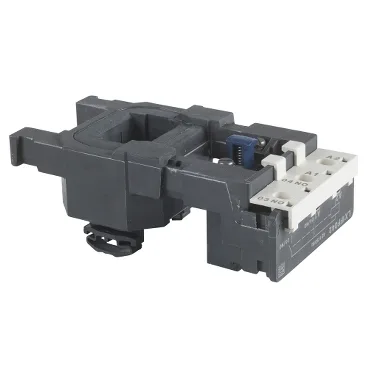
Control voltage and transformer sizing for the LX1FF048 coil
The LX1FF048 is the 48 V AC 50 Hz replacement coil for the TeSys F contactor range. The inrush draw is 550 VA at 50 Hz with a 0.3 power factor, dropping to 45 VA once the contactor seals. That 12:1 inrush-to-seal ratio means the control transformer must be sized for the inrush peak without saturating — a 100 VA transformer will drop below the 0.85 Uc pick-up threshold on the first half-cycle if the line impedance is high. The coil has no built-in suppressor module. The controls integrator must add an external RC snubber or a bidirectional TVS across the coil terminals to limit the inductive kick-back when the PLC output or relay contact opens. Without it, the flyback pulse can weld the driving contact or couple noise into the 24 V DC logic rail.
Pick-up and drop-out margins for brownout ride-through
The wide hysteresis means the contactor stays sealed through a 50 % voltage sag — useful for motor starter coordination during a line disturbance. If the control voltage is fed from a UPS with a 48 V nominal output that sags to 42 V during battery discharge, the coil still holds in.
Thermal load and cycling limits in a panel
The coil dissipates 12 to 16 W at 50 Hz when energised. In a sealed panel with multiple contactors running continuously, that heat adds up — a panel with six LX1FF coils on a production line dumps 72 to 96 W into the enclosure, enough to raise the internal temperature above the 131 °F (55 °C) operating limit if ventilation is inadequate. Maximum cycling rate is 2400 cycles per hour at 131 °F (55 °C), with a mechanical life of 10 million cycles. The closing time is 23 to 35 ms and opening time 5 to 15 ms. For a conveyor jogging at 40 cycles per minute (2400/h), the coil hits its mechanical life in about 70 days of continuous jogging — plan for a PM swap at that interval.
Coil DC parameters for snubber and diagnostic circuit design
The closed-circuit inductance is 0.16 H and the average DC resistance is 1.17 Ω at 68 °F (20 °C). The steady-state DC current is roughly 41 A — that sounds high, but remember this is an AC coil; the impedance at 50 Hz is dominated by the inductive reactance (j50.3 Ω), not the DC resistance. The DC values matter for sizing a suppression network: the RC snubber time constant should be below the coil's L/R ratio to avoid delaying the drop-out.