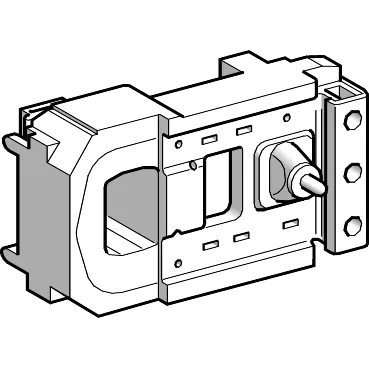
The LX9FL932 is a specific contactor coil from the Schneider Electric TeSys F range, designed to replace the coil in a TeSys F contactor when the control circuit needs 220 V AC or 220 V DC. It's a low-consumption coil — pulls 48 W holding at 20 °C, with an inrush of 733 W at the same temperature — so the thermal load on the panel stays manageable. The coil technology is without a built-in suppressor module, meaning you'll need to add an external RC snubber or varistor across the coil if the PLC output or relay driving it doesn't already have suppression.
The control circuit voltage is 220 V DC and 220 V AC, so it works on either supply — handy if your control transformer is AC but you have a DC bus elsewhere. The operational limits are 0.85 to 1.1 Uc at 55 °C, meaning the coil will pick up reliably between 187 V and 242 V; drop-out happens between 30% and 50% of Uc (66 V to 110 V), so it won't drop out on a brief sag. Heat dissipation runs 22.8 to 27.8 W, which matters for enclosure sizing — that's roughly the heat of a small soldering iron running continuously inside the panel. Mechanical durability is 5 million cycles, typical for a contactor coil of this class; the maximum operating rate is 1800 cycles per hour at 70 °C, so it's fine for frequent switching applications like conveyor cycling or compressor staging.
The coil mounts directly into the TeSys F contactor frame — it's a drop-in replacement, not a separate DIN-rail component. Opening time is 60 ms, closing time 20 ms; those are the mechanical stroke times, so factor them into your safety circuit response if the contactor is part of a guard interlock. The average resistance is 64.5 Ω inrush and 518 Ω holding at 20 °C — useful for calculating the actual current draw if you're sizing the control transformer or the DC power supply. No built-in suppressor means the coil's inductance of 3.6 H (closed circuit) will generate a flyback voltage spike on de-energization; fit a diode (for DC) or a varistor (for AC) across the coil terminals to protect the driving contact.