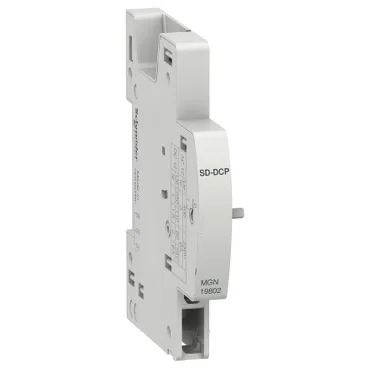
The control circuit accepts 230...400 V AC 50/60 Hz or 24...250 V DC, making it usable across both mains-voltage and low-voltage DC control schemes.
Rated current by voltage and duty
The switching capacity is specified per the EN/IEC 60947-5-1 standard. At 230 V AC 50 Hz it carries 6 A; at 400 V AC 50 Hz it carries 3 A. On the DC side the rating drops with voltage: 6 A at 24 V DC, 2 A at 60 V DC, 1.5 A at 110 V DC, and 1 A at 250 V DC. This derating curve is typical for DC interruption — the arc is harder to extinguish at higher voltages, so the contact gap limits the current. For a sourcing decision, match the load voltage and current to the appropriate row; the 6 A AC rating at 230 V is the headline figure for most panel fault-signal circuits.
Dimensions are 85 mm high, 76 mm deep, and 9 mm wide — one pitch. The bottom screw-clamp terminals accept one rigid cable 0.25...4 mm² or one flexible cable 0.25...2.5 mm² (with ferrule up to 2.5 mm²). Two 1.5 mm² rigid cables can share a terminal. Wire strip length is 6 mm; tightening torque is 0.6 N·m. The 9 mm width means it fits tightly in a crowded row — plan your terminal numbering accordingly.
The part is certified to EN/IEC 60947-5-1, the standard for control-circuit devices and switching elements. No RoHS or REACH documentation is carried in this record; for compliance documentation requests, include them in the RFQ.