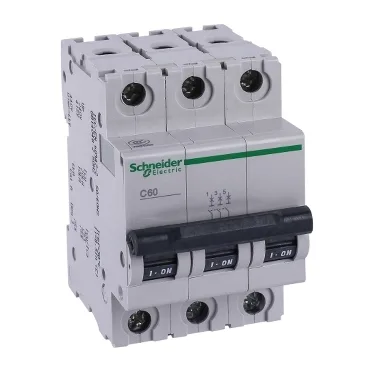
It's a 3-pole unit built to EN/IEC 60947-2, Category A, meaning it's designed for distribution-level overcurrent protection where the short-circuit rating matters more than selectivity coordination with downstream devices. Breaking capacity is 30 kA Icu at 240 V AC phase-to-phase, 15 kA at 415 V AC, and 10 kA at 440 V AC — all conforming to EN/IEC 60947-2. The Ics (service breaking capacity) is 50% of Icu at those AC voltages, and 100% at 125 V DC, so it clears faults and can be reclosed after a downstream event at the rated service level.
Snaps onto 35 mm symmetrical DIN rail (EN 60715). The 54 mm width for 3 poles (6 x 9 mm pitches) is standard — fits a 6-module slot in any distribution board. Depth is 73 mm, which clears most standard enclosures; check gland-plate clearance if the panel is shallow. That's a solid connection for panel wiring — no ferrules needed for stranded, but they're fine if you use them.
The C-curve trips magnetically at 8.5 x In (±20%), so the 6 A unit holds through motor inrush up to about 51 A peak and clears faster on higher faults. That's the standard choice for general distribution and moderate inductive loads — not for high-inrush transformers or long cable runs where a D-curve might be needed. The DC breaking capacity is 25 kA Icu at 125 V DC — useful for DC bus protection in drives or battery-backed circuits.