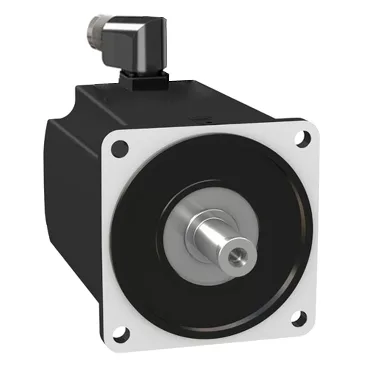
Servo motor, not a generic induction drive
The MH31901P02A2200: A bare induction motor on the same shaft envelope would deliver that mechanical power only at a single rated point; the servo configuration gives a controlled torque loop across the speed range.
Torque envelope and what each band actually drives
Continuous stall torque is 30 N.m at a continuous stall current of 23.2 A; peak stall torque reaches 110 N.m with a maximum Irms of 89.6 A. Peak torque is the figure that decides whether the motor can accelerate a heavy load through a fast index — sizing reference MH31901P — while the continuous figure governs thermal steady state in horizontal-axis packaging machinery and indexing conveyors. Maximum mechanical speed is 3800 rpm, derated against a back-EMF constant of 87.6 V/krpm at 115...480 V three-phase. Continuous power is rated 6750 W with copper-hot limit at 135 °C — natural convection cooling only, no integrated fan. A panel spec that puts this motor inside a sealed cabinet must verify the local ambient keeps the case temperature below the 135 °C copper-hot ceiling; otherwise derating begins.
Feedback, shaft, and panel-side mechanical fit
Encoder feedback is multiturn SinCos on Hiperface, with rotatable right-angled connectors — the connector orientation matters when the motor lands inside a tight machine frame, and the rotatable body lets the installer clock the connector without re-routing the cable. The shaft is a smooth 38 mm diameter with an 80 mm shaft length and no second shaft end; no holding brake is fitted, so an external safety brake or a vertical-axis back-drive analysis is on the integrator. Mounting is an international standard flange with four 14 mm mounting holes on a 180 mm centring collar 4 mm deep, body length 190 mm. Maximum radial force Fr on the shaft runs 2900 N at 1000 rpm down to 2600 N at 4000 rpm — when a belt or pinion sits on this shaft, the overhung load calculation uses the Fr figure at the operating rpm, not the highest headline number, because the allowable force drops as speed rises. IP65 standard on the body holds for washdown-adjacent duty and food-and-beverage lines when the connector face is mated with a sealed cable gland. With natural convection cooling, the IP65 enclosure does not need a fan cut-out, so the sealing integrity is a single integrity check at installation rather than an ongoing airflow concern.
Lifecycle and category sourcing reality
For a panel builder running a multi-axis machine build, that framing means the servo motor lands on the same BOM cycle as the drive — one RFQ, one lead-time line item.