Torque and speed — the two axes that size this motor into a machine
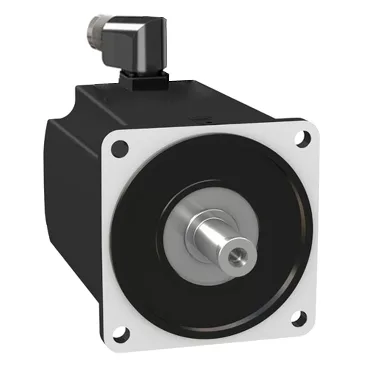
The MH31901P06A2200 is a three-phase MH3 servo motor in a 190 mm flange frame — one stack length — delivering 16.5 N·m nominal torque at 3000 rpm, with 30 N·m continuous stall torque and 110 N·m peak stall torque available for dynamic cuts and acceleration events. Nominal torque of 16.5 N·m at 3000 rpm corresponds to a continuous power output of roughly 5.2 kW — the 6750 W continuous power figure in the specs refers to the electrical input; the mechanical output is set by the torque-speed curve, not the input wattage. Peak stall torque of 110 N·m is the available torque for short-duration events — rapid acceleration, cutting loads, or inertial compensation. Sustained operation must stay within the continuous stall envelope of 30 N·m, or the motor overheats against its natural-convection thermal limit.
Encoder type drives drive compatibility — and the no-brake decision
The SinCos singleturn Hiperface encoder resolves position in a single mechanical revolution with 16-bit resolution — it is a position-feedback device, not a multi-turn absolute system. For applications requiring absolute position across multiple turns, a different encoder variant is needed; this motor is not equipped with one. The encoder pairs with Siemens drives identified in the sizing reference: the LXM52 at 14 mA command current, 400 V or 480 V; or the LXM62 at the same command current. The torque constant of 1.3 N·m/A at 120 °C winding temperature links the drive's current command directly to the mechanical output — sizing the drive around the motor's current draw, not its nameplate power. No holding brake is fitted. The motor relies entirely on the drive'sregenerative or external braking method to hold position when de-energised. If the axis must retain position during a power-loss event — a vertical axis, a gravity-loaded mechanism, or a safety-critical hold — a brake-equipped variant from the same series is the correct choice.
Mechanical fit and sealing for industrial deployment
The shaft is a smooth 38 mm diameter, 80 mm long, with no key or second shaft end — the driven load couples via a compression collar or clamp-style hub. Maximum radial force permissible drops from 2900 N at 1000 rpm to 2600 N at 4000 rpm; the coupling attachment must stay within this limit or the bearing preload is compromised over the motor's service life. IP65 sealing protects the motor housing against dust and low-pressure water spray — suitable for sealed enclosure environments and factory-floor mounting where washdown pressure is not directed at the motor. The rotatable right-angled connectors allow the cable entry to swing to the most convenient panel routing direction after final positioning. The international standard flange mounts directly to any machine frame or coupling housing sized to the 190 mm bolt circle — centring collar diameter is 180 mm with a 4 mm collar depth, and the four mounting holes accept 14 mm fasteners. Maximum mechanical speed is 3800 rpm — the motor can run above its 3000 rpm nominal point within the 3800 rpm limit, but torque falls off as speed rises; the peak stall torque of 110 N·m is only available at low speed, and the continuous stall torque of 30 N·m derates toward the no-load speed.
Current production — quoted to order against your BOM
The lifecycle stage is listed as current. Quoted to order through independent distribution — availability and current lead times confirmed at RFQ. The stator resistance of 0.24 Ohm and inductance of 5.08 mH are consistent with a low-loss winding design typical of this power class; verify these match the drive's line-filter and pre-charge sizing before commissioning.